Thursday, November 17, 2011

2011 Holiday Events I -- Colonial Revelers

(Latest events listed first. Scroll down for more.)

Friday, December 2, 6-8:30 pm

Holiday Stroll at Historic Yellow Sprin
gs

West Pikeland Cultural Center and the Lincoln Building
1645 Art School Road to 1685 Art School Road
Chester Springs, PA

Colonial Revelers will provide period music and carols at this free event, hosted by Historic Yellow Springs, Chester Springs Library and West Pikeland Township.

Beginning at the Cultural Center, with the tree lighting ceremony followed by carol singing and refreshments. Then enjoy a stroll to the Lincoln Building where holiday crafts will be enjoyed by the children. A story time with the Chester Springs Library will also highlight the festive activities planned and Santa will be there. Special food treats will be available to continue the celebration.

http://www.yellowsprings.org/holidaystroll.html for more information.
_________________

Saturday, November 26 10-4 pm

Brandywine Battlefield Patriots Day

1491 Baltimore Pike
Chadds Ford, Pa 19317

Adults: $6, Seniors: $4
Youth/Student: $3, Under 5: Free
10% holiday discount in the Museum Shop

Colonial Revelers will sing and stroll the grounds for this all-day event.  Living history regiments will present firing and medical demonstrations, 18th century sutlers will sell all sorts of goods and baked items, plus you can tour the historic buildings and museum.

Check out the battlefield calendar for more info.

On September 11, 1777, Washington's troops met the British and Hessians under General Howe at Brandywine for the largest battle of the Revolution.

Your humble servants,
HH

Friday, October 28, 2011

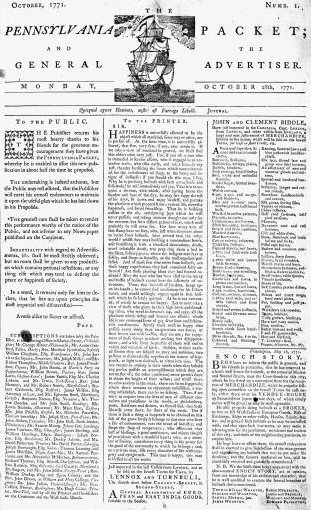
The Pennsylvania Packet - Facebook of the American Revolution


To the free and independent ELECTORS of the City of PHILADELPHIA.

. . The custom has been to deny the right of voting to all persons who have come from Germany, &c. until they have been naturalized, and taken such oaths as men now-a-days much object to; and what seems peculiar to this city alone, all men below the estate of fifty pounds are precluded.  Now I must profess myself of the Forester’s opinion, that every man in the country who manifests a disposition to venture his all for the defence of its Liberty, should have a voice in its Councils. . . .

From an open letter published on April 29, 1776 in Dunlap's Pennsylvania Packet

In this day of protests and rebellions organized through Facebook and other online resources, we wonder how something like the American Revolution could have ever been organized and the word spread.

Every city in early America had a newpaper. These periodicals were small, usually 3 or 4 columns, only one page, and published at most a few times a week. They didn't have investigative reporters, but they would print just about any document brought in to them. These papers were delivered to those who could read and afford subscriptions, but were also read aloud in taverns and other gathering places.

In the 1770s, John Dunlap printed his Pennsylvania Packet three times a week. In 1780, he joined forces with David Claypoole who eventually took over publication. In 1784, the Packet became America's first daily newspaper.

 
The Pennsylvania Packet was the first paper to print The Declaration of Independence on July 8, 1776 and, in 1787, the first to print The United States Constitution. Throughout the Revolution, Dunlap printed open letters, such as the one above. Many of Thomas Paine's letters were published, which he frequently signed "Common Sense" or merely, "C.S." Paine's essay Common Sense was originally printed as a brochure, but the full text appeared in the Packet at the end of the war.

Francis Hopkinson, signer of the Declaration, wrote many essays and poems for the Packet. His "Battle of the Kegs", a parody describing events of British-occupied Philadelphia, was published in March of 1778 and his tribute to General Washington, titled "A Toast" came out the next month.

"A Toast" can be heard on Colonial Revelers 1st CD, Revelry, Reflection & Revolution, along with  "God Save Our Thirteen States," printed in the Pennsylvania Packet in 1779.

Your humble servants,
HH

Monday, September 26, 2011

October 2011 Events

(latest first)

Saturday, October 8, 9 am - 4 pm - FREE
Downingtown Friends Fall Festival
800 Lancaster Avenue
Downingtown, PA

Colonial Revelers will perform at noon - a lunchtime concert of songs popular between 1700 and 1800.

In 1774, John Downing donated land for the Lionville Friends to build a school.  Friends around "Downing's Town" were granted permission to meet at the school in 1784.  In 1806, Jenu Roberts donated land for the building of a meetinghouse for Downingtown Friends.

For more information about Downingtown Friends and this event, click here, phone 610-269-4223 or email info@downingtownfriendsmeeting.org

~~~~~~~~~~~~

Saturday, October 1, 10 pm - 4 pm - FREE
Newlin Mill Fall Festival
219 South Cheyney Rd
Glen Mills, PA

Colonial Revelers will perform two sets of period music at 11:30 am and 1:30 pm. Also on hand will be living history and craft demonstrations and tours of the house and mill.

Newlin Mill is the oldest operating grist mill in Pennsylvania. It was built by Nathaniel Newlin in 1704, the third mill built on the site by the Newlin family, who had come to America in 1683. The mill was run by the Newlins until 1817, then by other owners through 1941. A descendent of the Newlin family bought it in 1958 and began restoring it to its 18th century appearance. Besides the mill, this living history site has two houses, an office, a barn and a grain storage building.

For more information about the park, its history, and this event click here , email
info@newlingristmill.org or call 610-459-2359.

Saturday, August 27, 2011

September 2011 Events


(latest first)

Sunday, September 18, Noon-4 pm
Stafford Heritage Picnic

Manahawkin Lake Park
49 West Bay Ave
(Rte 9 and Main Sts)
Manahawkin, NJ

Colonial Revelers will stroll around the lake and sing at this great multi-era living history event.

In the early part of the decade, Stafford Heritage Days took up a whole weekend and included a reenactment of the Battle of Cedar Bridge, the last engagement of the Revolution (darn those New Jersey loyalists!). Living history groups of all eras showed up, including colonial pirates, temperance ladies, a vintage baseball team, and the most eerily realistic General Grant, Chamberlain and Mr. and Mrs. Lincoln you'd ever want to meet. Then the recession hit, resources were limited and the project was put on hold. This year, we're glad to see a  comeback. Come out and join us. It's always fun.

~~~~~~~~~~~

Sunday, September 11, 11 am - 3 pm
Battle of Brandywine Reenactment
Brandywine Battlefield
Route 1
Chadds Ford, PA

Colonial Revelers will provide period music in the living history area whenever guns and cannons are silent.

The Battle of Brandywine took place on September 11, 1777 and was the largest battle of American Revolution, with Washington's forces numbering about 15,000 and the British with perhaps 17,000 troops. Washington held a decent position on the hills above the Brandywine Creek, but he was in a loyalist/pacifist neighborhood. Deliberate misinformation, poor communication, bad reconnaissance and inexperienced soldiers all contributed to the American defeat, yet they were able to retreat to Chester and regroup. The British were hampered by the heat of the day and the length of time they took to march around the American flank to ford the creek.

Come tour Washington's and Lafayette's Headquarters, view living history demonstrations, eat colonial food and, of course, hear Colonial Revelers sing.

Wednesday, August 3, 2011

In The Good Old Colony Days

by Elena Santangelo

Between the Declaration of Independence in 1776 and the Constitution eleven years later, the United States had no federal government and no federal taxes.  A Tea Partyers dream.

Only a loose Confederation held the states together.  Each state had its own laws, ways of raising revenue, and even its own paper currency.  Then again, not many folks wanted the bills anyway. The only money worth anything was gold and silver coins, and they were hard won. In those years, after fighting an expensive war, the country was broke and in its first economic depression.

Many of the soldiers who fought in the Continental Army weren't given their back pay or pensions. The states had their own militias to worry about. Greedy men took advantage of the situation, like the Morrises, who held a monopoly in trade agreements for tobacco.

Here's an old 17th century song that resurged in popularity during that decade:

In the Good Old Colony Days
When we lived under the king,
Lived a miller and a weaver and a little tailor--
Three jolly rogues of Lynn.

The first line says it all. In the 1780s, lots of folks lamented the "good old colony days" before the Revolution. The song goes on to tell how the miller stole corn, the weaver stole yarn, and "the little tailor, he stole broadcloth for to keep the three rogues warm."  The poor and working classes in America could more than identify with the rogues' need to provide themselves with food and clothing.

However, all sinners must be punished so

The miller drowned in his dam,
And the weaver hung in his yarn,
And the Devil laid his Claw on the little tailor
With the broadcloth under his arm.

Eventually, though, the Constitution provided for a strong and flexible Federal government and decent trade with Europe was established, bringing Americans fancy French imports like flannel, denin and corduroy (giving little tailors a wider choice of fabrics).

Still, while the America of the 1780s wasn't the government-less Utopia some citizens envision today, there was no Capitol Hill, and no Congress as we now know it. So how bad could it have been?

Friday, July 1, 2011

EVENTS

Sunday, July 3 at 9:30 am
St. Matthews United Methodist Church of Valley Forge
600 Walker Road
Wayne, PA 19087

On the eve of the anniversary of our Independency, Colonial Revelers will perform the music of Mr. William Billings and Mr. John Cole during Sunday morning services at St. Matthews.


Saturday, July 30, 10-4
Frederick Muhlenberg House
151 W. Main Street
Trappe, PA 19426

Colonial Revelers will provide 18th century songs from 11 to 1 at the Speaker's House Living History Day, a BBQ fundraiser for the restoration of the Frederick Muhlenberg House.  Lunch will be pork BBQ, cole slaw, corn-on-the-cob and soft drink.  Activities include colonial cooking, music, spinning, dying, weaving, blacksmithing, woodworking, military demonstrations and tours of the house.  Tickets are $10 for adults, $7 for seniors, $5 for kids 6-12, and free for children under 6.

Frederick Muhlenberg became the first U.S. Congress Speaker of the House in 1789. The house was built in 1760 and purchased by Muhlenberg in 1781.  He was born and grew up in Trappe.  The house of his father, Henry Melchior Muhlenberg, has also been restored by the Trappe Historical Society.  Henry was a Lutheran pastor sent to Pennsylvania in the 18th century as a missionary.  Besides Frederick, his sons included Major General Peter Muhlenberg of the Continental Army.  Sons-in-law were also generals and politicians, and one grandson became Governor of Pennsylvania.

For more information, call 610-489-2105 or email info@speakershouse.org

FYI: The Keystone Grange Fair is the same day, not far away on West 1st Avenue, 9 am-7 pm.  Come and spend the whole day in Trappe!

We would be pleased to see you this month.

Your humble servants,
HH

Friday, June 10, 2011

If You Can't Stand The Heat...

 
"Hide not your talents, they for use were made.
What's a sun-dial in the shade?"

Benjamin Franklin, Poor Richard's Almanack

Dear Patrons,

A suitable reply to the above question today might well be that a sun-dial in the shade would be cooler.

In an effort to provide relief to ourselves and our readers, we list here time-tested methods of dealing with the summer heat.


1.  If you must labor outside, a fresh, damp cabbage leaf placed 'twixt cap and head will keep you cooler.  This is a centuries old method, most recently employed famously by a ballplayer named Babe Ruth.  Change the leaf every few hours.

2.  Dig a hole.  On a hot summer's day, the bottom of a 6 foot hole will be at least 20 degrees Fahrenheit cooler than the top. For those who shy from this solution, likening it to being laid
untimely in their graves, perhaps use the hole only to store perishable food.  Add a large chunk of ice, well-salted and wrapped in flannel, and your milk, butter, and fresh meat will
keep well.

3.  Should digging a hole prove strenuous in the heat, you may lower your jugs of milk and such to the bottom of your well with the same results.

4.  For those fortunate to have a cellar beneath their homes, 'tis a fine, cool place to dwell on a warm afternoon, all the more so if no one thinks to look for you there.  Bring a book and a few pints of good ale (chilled first in the well) to help pass the hours.  If discretion is unnecessary, leave the book above and bring your friends below for an afternoon of song.

Your humble servants,
HH

Facebook Profile

Facebook Fan Page

|