Join the ensembles of Historical Harmonies this month as we celebrate the holiday season.
Friday, December 5
6 -9 pm
HOLIDAY CELEBRATION
Limerick Community Park
Swamp Pike & Ziegler Road
Limerick, PA
Victorian Carolers will perform holiday carols at this free event. Crafts, hot cocoa and cookies, and of course, Santa Claus. Bring a new unwrapped toy for Toys For Tots.
Saturday, December 6
3-7 pm
DECK THE ALLEY!
Elfreth's Alley Museum
Elfreth's Alley, Philadelphia, PA
Colonial Revelers will sing and perform antics on the oldest residential street in the U.S. as the neighbors open their colonial era homes to the public.
Unique holiday decorations, refreshments, carriage rides, story tellers,
authentic 18th Century mummers, as well as encounters with Ben
Franklin, Dolley Madison and colonial Pennsylvania’s own cranky Santa
“Belsnickel” himself.
Tickets are $25 for adults, $10 for children. Group rates available. Tickets at https://elfrethsalley.ticketleap.com/deck-the-alley-2014/dates/Dec-06-2014_at_0300PM
Friday, December 19
5:30-7 pm
THE "MARCH-IN" at VALLEY FORGE
Valley Forge National Historical Park
1400 North Outer Line Drive
Valley Forge, PA
Colonial Revelers will be stationed in the Visitor Center, singing 18th century wassail songs, Christmas hymns and other period music to commemorate the day the Continental Army arrived at Valley Forge in 1777. Come for the party!
Valley Forge National Historical Park is the site of the Continental Army's winter encampment, from December 19, 1777 to June 19, 1778. Park rangers and Friends of Valley Forge will be on hand for candlelight tours, a "march" up to Muhlenberg's huts, and other 18th century festivities. Refreshments, holiday shopping and free gift wrapping will be available at the Encampment Store at the Visitor Center. Free and open to the public.
Sunday, December 21
7-9 pm
COMMUNITY SOLSTICE SING
The Birdhouse Center for the Arts
7 North Main, Lambertville, NJ
Members of Historical Harmonies will add their voices and flair for mischief to the mix to celebrate the shortest day. Bring your favorite songbooks, instruments, drinks/food and friends for a cozy evening of community celebration! Refreshments provided but additional snacks and beverages welcome.
Tickets: $5 individual or $10 whole family. Seating is first come, first served.
The Birdhouse will also have free Morris Dancing in the afternoon from 4-6 pm.
Welcome Yule !
Historical Harmonies and Colonial Revelers bids you welcome! Here you'll find news of our events, as well as historical information about our music and the periods of history where you might have first heard it sung. Charge your glasses and make yourself comfortable by the fire.
Showing posts with label Colonial Revelers. Show all posts
Monday, December 1, 2014
Thursday, September 18, 2014
Colonial Revelers October Events
October is Harvest Festival time! Come hear Colonial Revelers at the following events:
Newlin Grist Mill Fall Harvest Festival
Saturday, October 4
10 am to 4 pm
219 Cheyney Rd (at Route 1)
Glen Mills, PA
Newlin Grist Mill was built in 1704 and operated commercially until 1941. Now it's a historic site and park. At their fall festival, the 18th century comes alive with the sights, sounds, and smells of colonial America. Tradesmen and artisans will demonstrate papermaking, colonial brewing, iron making, brickmaking, blacksmithing, historic baking, and milling throughout the day. Displays include bee skeps, colonial money, and chair caning. Stop by to see a dairy cow, heritage sheep, and chickens. Listen to colonial music, learn period dancing, play colonial games, decorate a pumpkin, and enjoy a hayride through the 160-acre grounds. Colonial Revelers will sing 2 sets, at about 11 am and 1 pm, right out in front of the house. You can't miss us.
Admission is free. Parking is $5 per car. More information at http://www.newlingristmill.org/#!fall-harvest-festival/c1m63
________________________
Downingtown Friends Meeting Fall Festival
Saturday, October 11
9 am to 4 pm
800 East Lancaster Ave.
Downingtown, PA
Colonial Revelers will perform for the lunch crowd at noon, and this year by special request, we'll be adding in a few of our 19th century seasonal songs into our mix of colonial church hymns, tavern songs and tunes from the Revolution.
Also at the festival you'll find craft vendors, live folk and rock music, Downingtown's famous Festival foods (their vegetarian chili is amazing!), and serious garage-sale finds at the Friends Mercantile. You'll be able to learn about the history of Downingtown Friends from the Quaker Heritage Exhibit inside, featuring antique Quaker clothing and memorabilia. At 1:30 pm, in authentic early American Quaker garb, the Friends will reenact the first wedding that took place at the meetinghouse in 1806. For the kids, they offer children’s crafts and games. There’s also a hay wagon ride and exceptional face painting for both kids and adults.
Admission and parking are free. Park across Lancaster Avenue. More info at http://downingtownfriendsmeeting.org/fallfestival.htm
Newlin Grist Mill Fall Harvest Festival
Saturday, October 4
10 am to 4 pm
219 Cheyney Rd (at Route 1)
Glen Mills, PA
Newlin Grist Mill was built in 1704 and operated commercially until 1941. Now it's a historic site and park. At their fall festival, the 18th century comes alive with the sights, sounds, and smells of colonial America. Tradesmen and artisans will demonstrate papermaking, colonial brewing, iron making, brickmaking, blacksmithing, historic baking, and milling throughout the day. Displays include bee skeps, colonial money, and chair caning. Stop by to see a dairy cow, heritage sheep, and chickens. Listen to colonial music, learn period dancing, play colonial games, decorate a pumpkin, and enjoy a hayride through the 160-acre grounds. Colonial Revelers will sing 2 sets, at about 11 am and 1 pm, right out in front of the house. You can't miss us.
Admission is free. Parking is $5 per car. More information at http://www.newlingristmill.org/#!fall-harvest-festival/c1m63
________________________
Downingtown Friends Meeting Fall Festival
Saturday, October 11
9 am to 4 pm
800 East Lancaster Ave.
Downingtown, PA
Colonial Revelers will perform for the lunch crowd at noon, and this year by special request, we'll be adding in a few of our 19th century seasonal songs into our mix of colonial church hymns, tavern songs and tunes from the Revolution.
Also at the festival you'll find craft vendors, live folk and rock music, Downingtown's famous Festival foods (their vegetarian chili is amazing!), and serious garage-sale finds at the Friends Mercantile. You'll be able to learn about the history of Downingtown Friends from the Quaker Heritage Exhibit inside, featuring antique Quaker clothing and memorabilia. At 1:30 pm, in authentic early American Quaker garb, the Friends will reenact the first wedding that took place at the meetinghouse in 1806. For the kids, they offer children’s crafts and games. There’s also a hay wagon ride and exceptional face painting for both kids and adults.
Admission and parking are free. Park across Lancaster Avenue. More info at http://downingtownfriendsmeeting.org/fallfestival.htm
Monday, September 24, 2012
October 2012 Events
(latest first)
Saturday, October 13, 2012
9 am to 4 pm
800 E. Lancaster Ave.
Downingtown, PA 19335
Colonial Revelers will sing a concert of 18th century music at noon. Besides the music on the mainstage, the Festival offers delicious foods, children's activities, plants, crafts, and white-elephant sales, all on the grounds of this beautiful historic meeting house. At 1:30 is the annual authentic reenactment of an 1806 Quaker wedding.
Admission is free and so is the parking, across the street. For more information and directions, go to Downingtown Friend's Festival page.
~~~~~~~~~~~~~~~~~~.
Saturday, October 6, 2012
10 am to 4 pm
219 South Cheyney Rd (Routes 1 and 322)
Glen Mills, PA 19342
Colonial Revelers will perform at 11 am and 1 pm. In between you can listen to period harp and mandolin music as you stroll around the grounds, meeting over 20 living history demonstrators plying colonial crafts and trades such as spinning, blacksmithing, brick making, and weaving. Colonial meals will be prepared over open hearths and you can watch the mill in action.
This event is free of charge. Go to Newlin Mill's site for more information and directions.
Saturday, October 13, 2012
9 am to 4 pm
Downingtown Friends Meeting Fall Festival
Downingtown Friends Meeting 800 E. Lancaster Ave.
Downingtown, PA 19335
Colonial Revelers will sing a concert of 18th century music at noon. Besides the music on the mainstage, the Festival offers delicious foods, children's activities, plants, crafts, and white-elephant sales, all on the grounds of this beautiful historic meeting house. At 1:30 is the annual authentic reenactment of an 1806 Quaker wedding.
Admission is free and so is the parking, across the street. For more information and directions, go to Downingtown Friend's Festival page.
~~~~~~~~~~~~~~~~~~.
Saturday, October 6, 2012
10 am to 4 pm
Newlin Grist Mill Fall Harvest Festival
Newlin Grist Mill219 South Cheyney Rd (Routes 1 and 322)
Glen Mills, PA 19342
Colonial Revelers will perform at 11 am and 1 pm. In between you can listen to period harp and mandolin music as you stroll around the grounds, meeting over 20 living history demonstrators plying colonial crafts and trades such as spinning, blacksmithing, brick making, and weaving. Colonial meals will be prepared over open hearths and you can watch the mill in action.
This event is free of charge. Go to Newlin Mill's site for more information and directions.
Friday, September 14, 2012
September 2012 Events
(latest first)
Saturday, September 22, 2012
9 am to 5 pm
Montgomery County History Fair
Augustus Lutheran Church717 West Main St.
Trappe, PA
Colonial Revelers, in costume, will provide music for this unique living history experience. More than 30 historical societies, living history and civic organizations will be present, plus food and other vendors.
For more information, go to the W.S. Hancock Society web page.
~~~~~~~~~~~~~~~~~~~
Sunday, September 16, 2012 9:30 am to 11 am
St. Thomas Church History Day
St. Thomas Church, Whitemarsh
Bethlehem Pike and Camp Hill Rds
Fort Washington, PA
Colonial Revelers will sing at the end of the 9:30 service, then downstairs for a signing of a book about the church's history.
For more info, go to St. Thomas's site.
Wednesday, July 25, 2012
We Love A Parade
"...in passing thro' the City...great attention given by the officers to see that the men carry their arms well, and are made to appear as decent as circumstances will admit."
Washington's orders, Aug. 23, 1777
On August 24, 1777, Front Street in Philadelphia was the site of a Grand Parade of the Continental Army. The troops were on their way south, to defend the city from the British who were landing along the Chesapeake. Washington decided to take advantage of the situation to flaunt his troops, hoping to win support from the citizens. He took the precaution of sending some of the sutlers and less reputable camp followers (i.e. whores) down to Delaware by another route.
The word "parade"--coined in the 17th century--originally meant to prepare and was used in a military context. Parade grounds were places for troops to practice maneuvers and eventually to display the troops abilities to superior officers and important visitors. This sort of formal, ceremonial marching came to be known in itself as a parade. If the troops were cavalry, it was called a cavalcade.
In the 18th century, "parades" were always military. Civilians held processions or promenades, for weddings, funerals, religious feasts, and holidays like May Day.
By the mid-19th century, the distinctions began to fade. After the Civil War, veterans groups and Ladies Auxiliaries joined military parades held in cities and towns for holidays. Civic bands joined in, then Temperance Leagues, Scout troops, school bands, athletes and cheerleaders. As towns acquired fancy new equipment for their fire and police departments, they'd shine them up to show off to the spectators. And, naturally, all the local politicians would be in attendance, dressed up in their best and waving flags.
Parade floats supposedly got their start in the Middle Ages, when traveling passion plays put their scenery on horse wagons. The name "float" came from the decorated barges on the Seine during the Lord Mayor's Show, a public holiday in London. And, of course, traveling circuses also used floats to arouse interest in their shows. After World War II, even the military used floats, topped by large cannons and missiles.
This past July 4th, we in Colonial Revelers walked in our first parade. In front of us were County Sheriff Department vehicles. Behind were kids from the local Tai Kwan Do school. The parade included all the traditional participants--high school band, church groups, fire trucks--but also motorcycle clubs, and even a paranormal investigation team.
The best thing about the parade were all the spectators, people from all races, religions and walks of life, all smiling, cheering and waving American flags. We discovered that day that the parade in America had evolved into something that brought everyone together.
Looking forward to next year.
Your obedient servants,
HH
Washington's orders, Aug. 23, 1777
On August 24, 1777, Front Street in Philadelphia was the site of a Grand Parade of the Continental Army. The troops were on their way south, to defend the city from the British who were landing along the Chesapeake. Washington decided to take advantage of the situation to flaunt his troops, hoping to win support from the citizens. He took the precaution of sending some of the sutlers and less reputable camp followers (i.e. whores) down to Delaware by another route.
The word "parade"--coined in the 17th century--originally meant to prepare and was used in a military context. Parade grounds were places for troops to practice maneuvers and eventually to display the troops abilities to superior officers and important visitors. This sort of formal, ceremonial marching came to be known in itself as a parade. If the troops were cavalry, it was called a cavalcade.
In the 18th century, "parades" were always military. Civilians held processions or promenades, for weddings, funerals, religious feasts, and holidays like May Day.
By the mid-19th century, the distinctions began to fade. After the Civil War, veterans groups and Ladies Auxiliaries joined military parades held in cities and towns for holidays. Civic bands joined in, then Temperance Leagues, Scout troops, school bands, athletes and cheerleaders. As towns acquired fancy new equipment for their fire and police departments, they'd shine them up to show off to the spectators. And, naturally, all the local politicians would be in attendance, dressed up in their best and waving flags.
Parade floats supposedly got their start in the Middle Ages, when traveling passion plays put their scenery on horse wagons. The name "float" came from the decorated barges on the Seine during the Lord Mayor's Show, a public holiday in London. And, of course, traveling circuses also used floats to arouse interest in their shows. After World War II, even the military used floats, topped by large cannons and missiles.
The best thing about the parade were all the spectators, people from all races, religions and walks of life, all smiling, cheering and waving American flags. We discovered that day that the parade in America had evolved into something that brought everyone together.
Looking forward to next year.
Your obedient servants,
HH
Wednesday, January 25, 2012
You Couldn't Drink the Water, or Could You?
"Take counsel in wine, but resolve afterwards in water."
Poor Richard's Almanac, 1733
Singing colonial drinking songs often leads to questions and discussions of the drinking habits of 18th century Americans, who consumed an incredible amount of beer, wine and spirits. So much so that respected persons of the time, such as Benjamin Rush and Ben Franklin, began to preach the virtues of temperance.
Beer was the everyday drink, both strong (full-strength) and small (watered down). Even children were given small beer. The traditional answer as to why this was done is "The water wasn't safe."
Lately I've heard some historians claim this is balderdash, that one reason colonists headed for America in the first place were reports of how clean the streams and rivers were. Colonial settlers didn't know about bacteria, per se, but they did often boil water and scald milk before ingestion, especially if the
liquid seemed "befouled" (smelled bad or was oddly colored or had obvious slime).
So why exactly wouldn't the water be safe? Same reason as today. Industrial pollution.
As small towns and settlements sprung up along creeks and rivers, so did mills and other businesses. Anyone who needed water or water power for his trade built as close to the streams as possible. This included grist, paper, and textile mills, tanners, blacksmiths, iron furnaces, forges, saw mills, and carpenters. All of them created waste products and many of those wastes were returned to the waterway. The water could contain lime, lye, and metals, among other pollutants. Using a bit of beer to at least hide the bad taste made sense.
Even if the water was safe, beer was used for basic nutrition. Doing typical 18th century farmwork, each adult could easily burn 4000 calories per day. Beer provided extra calories, nutrients and carbohydrates in a fairly easy to consume form. When the Temperance Movement started to convince people to switch from small beer to tea in the early 19th century, malnutrition was noted among farmers and other more vigorous trades.
Whatever the answer, colonial Americans liked their drink, particularly beer, and wouldn't be denied it, even if that meant being creative.
If barley be wanting to make into malt
We must be contented and think it no fault
For we can make liquor, to sweeten our lips,
Of pumpkins and parsnips and walnut-tree chips.
American folk song, circa 1630
Your servants,
HH
Poor Richard's Almanac, 1733
Singing colonial drinking songs often leads to questions and discussions of the drinking habits of 18th century Americans, who consumed an incredible amount of beer, wine and spirits. So much so that respected persons of the time, such as Benjamin Rush and Ben Franklin, began to preach the virtues of temperance.
Beer was the everyday drink, both strong (full-strength) and small (watered down). Even children were given small beer. The traditional answer as to why this was done is "The water wasn't safe."
Lately I've heard some historians claim this is balderdash, that one reason colonists headed for America in the first place were reports of how clean the streams and rivers were. Colonial settlers didn't know about bacteria, per se, but they did often boil water and scald milk before ingestion, especially if the
liquid seemed "befouled" (smelled bad or was oddly colored or had obvious slime).
So why exactly wouldn't the water be safe? Same reason as today. Industrial pollution.
As small towns and settlements sprung up along creeks and rivers, so did mills and other businesses. Anyone who needed water or water power for his trade built as close to the streams as possible. This included grist, paper, and textile mills, tanners, blacksmiths, iron furnaces, forges, saw mills, and carpenters. All of them created waste products and many of those wastes were returned to the waterway. The water could contain lime, lye, and metals, among other pollutants. Using a bit of beer to at least hide the bad taste made sense.
Even if the water was safe, beer was used for basic nutrition. Doing typical 18th century farmwork, each adult could easily burn 4000 calories per day. Beer provided extra calories, nutrients and carbohydrates in a fairly easy to consume form. When the Temperance Movement started to convince people to switch from small beer to tea in the early 19th century, malnutrition was noted among farmers and other more vigorous trades.
Whatever the answer, colonial Americans liked their drink, particularly beer, and wouldn't be denied it, even if that meant being creative.
If barley be wanting to make into malt
We must be contented and think it no fault
For we can make liquor, to sweeten our lips,
Of pumpkins and parsnips and walnut-tree chips.
American folk song, circa 1630
Your servants,
HH
Tuesday, December 27, 2011
An Old English Twelfth Night
We've told you about Twelfth Night celebrations on this blog . Now, if you're in the Philadelphia area, you can experience one for yourself.
Greene & Westview Sts.
Philadelphia, PA
Germantown Country Dancers will host this festive celebration of music, dance, traditional merriment, singing, laughter and, naturally, refreshments. Besides our Colonial Revelers, who will provide period seasonal songs, expect Morris dancers, country dances, and the crowning of a Twelfth Night King and Queen. Lots of audience participation. Please join us!
Admission: Adults, $5; under 18, $2; family maximum, $15.
For more information, call 610-645-0725 or
http://www.germantowncountrydancers.org/
Saturday, January 7, 2012
3-5 pm
Summit Presbyterian Church Greene & Westview Sts.
Philadelphia, PA
Germantown Country Dancers will host this festive celebration of music, dance, traditional merriment, singing, laughter and, naturally, refreshments. Besides our Colonial Revelers, who will provide period seasonal songs, expect Morris dancers, country dances, and the crowning of a Twelfth Night King and Queen. Lots of audience participation. Please join us!
Admission: Adults, $5; under 18, $2; family maximum, $15.
For more information, call 610-645-0725 or
http://www.germantowncountrydancers.org/
Tuesday, November 29, 2011
2011 Holiday Events II -- Colonial Revelers & Victorian Carolers
(Latest events listed first. Scroll down for more.)
Monday, December 19, 5:30-7 pm
The "March-In" at Valley Forge
Valley Forge National Historical Park
1400 North Outer Line Drive
Valley Forge PA 19406
Colonial Revelers will be stationed in the Visitor Center, singing 18th century wassail songs, Christmas hymns and other period music to commemorate the day the Continental Army arrived at Valley Forge in 1777. Come for the party!
Valley Forge National Historical Park is the site of the Continental Army's winter encampment, from December 19, 1777 to June 19, 1778. Park rangers and Friends of Valley Forge will be on hand for candlelight tours, a "march" up to Muhlenberg's huts, and other 18th century festivities. Refreshments, holiday shopping and free gift wrapping will be available at the Encampment Store at the Visitor Center. Free and open to the public.
Information and directions at http://www.nps.gov/vafo/planyourvisit/events.htm or call 610-783-1099
_________________
Friday, December 16, 6-8:30 pm
Candlelight Tours
The Mill at Anselma
1730 Conestoga Road
Chester Springs, PA
Our Victorian Carolers ensemble will regale vistors to the mill with traditional holiday songs from Charles Dickens's England.
Anselma Mill on Pickering Creek was operated as a grist mill from 1725 to 1982 and retains its Colonial era power train from 1747. In 2005, the Mill at Anselma was designated a National Historic Landmark. Today, it's the most complete known example of a custom grain mill in the United States.
For further information about the mill or this event, call them at 610-827-1906, email info@anselmamill.org or click here for their website.
____________
Saturday, December 10, 4-6 pm
Marshallton Tree Lighting
Village of Marshallton
559 Northbrook Rd
West Chester, PA 19382
Colonial Revelers will return to Martin's Tavern to provide holiday music for the lighting of the village tree.
Martin's Tavern, also called Center House, was built in 1764. The inn played a prominent role during the Battle of Brandywine in 1777. The restored ruins of the tavern form Marshallton's village square, where a large evergreen tree is decorated with lights each year. Refreshments will be served.
Find out about Martin's Tavern events: http://taproom.martinstavern.org/
________________
Saturday, December 3, 3-7 pm
Candlelight Tours of Phoenixville
Historical Society of the Phoenixville Area
204 Church Street
Phoenixville, PA 19460
As a stop on the tour, Victorian Carolers will perform in the sanctuary of the old church that serves as the Society's Headquarters. We'll be there until 5:30 pm, so come early.
Tour beautifully decorated houses and historical churches. Refreshments will be served. Advance Tickets: $20; Day of the Tour: $25. All proceeds benefit the The Phoenixville Library and The Clinic. On Saturday, meet at the Phoenixville Senior Center,153 Church St. Doors open at 2:30. For more information, call the Society at 610-935-7646.
Your Servants,
HH
Monday, December 19, 5:30-7 pm
The "March-In" at Valley Forge
Valley Forge National Historical Park
1400 North Outer Line Drive
Valley Forge PA 19406
Colonial Revelers will be stationed in the Visitor Center, singing 18th century wassail songs, Christmas hymns and other period music to commemorate the day the Continental Army arrived at Valley Forge in 1777. Come for the party!
Valley Forge National Historical Park is the site of the Continental Army's winter encampment, from December 19, 1777 to June 19, 1778. Park rangers and Friends of Valley Forge will be on hand for candlelight tours, a "march" up to Muhlenberg's huts, and other 18th century festivities. Refreshments, holiday shopping and free gift wrapping will be available at the Encampment Store at the Visitor Center. Free and open to the public.
Information and directions at http://www.nps.gov/vafo/planyourvisit/events.htm or call 610-783-1099
_________________
Friday, December 16, 6-8:30 pm
Candlelight Tours
The Mill at Anselma
1730 Conestoga Road
Chester Springs, PA
Our Victorian Carolers ensemble will regale vistors to the mill with traditional holiday songs from Charles Dickens's England.
Anselma Mill on Pickering Creek was operated as a grist mill from 1725 to 1982 and retains its Colonial era power train from 1747. In 2005, the Mill at Anselma was designated a National Historic Landmark. Today, it's the most complete known example of a custom grain mill in the United States.
For further information about the mill or this event, call them at 610-827-1906, email info@anselmamill.org or click here for their website.
____________
Saturday, December 10, 4-6 pm
Marshallton Tree Lighting
Village of Marshallton
559 Northbrook Rd
West Chester, PA 19382
Colonial Revelers will return to Martin's Tavern to provide holiday music for the lighting of the village tree.
Martin's Tavern, also called Center House, was built in 1764. The inn played a prominent role during the Battle of Brandywine in 1777. The restored ruins of the tavern form Marshallton's village square, where a large evergreen tree is decorated with lights each year. Refreshments will be served.
Find out about Martin's Tavern events: http://taproom.martinstavern.org/
________________
Saturday, December 3, 3-7 pm
Candlelight Tours of Phoenixville
Historical Society of the Phoenixville Area
204 Church Street
Phoenixville, PA 19460
As a stop on the tour, Victorian Carolers will perform in the sanctuary of the old church that serves as the Society's Headquarters. We'll be there until 5:30 pm, so come early.
Tour beautifully decorated houses and historical churches. Refreshments will be served. Advance Tickets: $20; Day of the Tour: $25. All proceeds benefit the The Phoenixville Library and The Clinic. On Saturday, meet at the Phoenixville Senior Center,153 Church St. Doors open at 2:30. For more information, call the Society at 610-935-7646.
Your Servants,
HH
Thursday, November 17, 2011
2011 Holiday Events I -- Colonial Revelers
(Latest events listed first. Scroll down for more.)
Friday, December 2, 6-8:30 pm
Holiday Stroll at Historic Yellow Springs
West Pikeland Cultural Center and the Lincoln Building
1645 Art School Road to 1685 Art School Road
Chester Springs, PA
Colonial Revelers will provide period music and carols at this free event, hosted by Historic Yellow Springs, Chester Springs Library and West Pikeland Township.
Beginning at the Cultural Center, with the tree lighting ceremony followed by carol singing and refreshments. Then enjoy a stroll to the Lincoln Building where holiday crafts will be enjoyed by the children. A story time with the Chester Springs Library will also highlight the festive activities planned and Santa will be there. Special food treats will be available to continue the celebration.
http://www.yellowsprings.org/holidaystroll.html for more information.
_________________
Saturday, November 26 10-4 pm
Brandywine Battlefield Patriots Day
1491 Baltimore Pike
Chadds Ford, Pa 19317
Adults: $6, Seniors: $4
Youth/Student: $3, Under 5: Free
10% holiday discount in the Museum Shop
Colonial Revelers will sing and stroll the grounds for this all-day event. Living history regiments will present firing and medical demonstrations, 18th century sutlers will sell all sorts of goods and baked items, plus you can tour the historic buildings and museum.
Check out the battlefield calendar for more info.
On September 11, 1777, Washington's troops met the British and Hessians under General Howe at Brandywine for the largest battle of the Revolution.
Your humble servants,
HH
Friday, December 2, 6-8:30 pm
Holiday Stroll at Historic Yellow Springs
West Pikeland Cultural Center and the Lincoln Building
1645 Art School Road to 1685 Art School Road
Chester Springs, PAColonial Revelers will provide period music and carols at this free event, hosted by Historic Yellow Springs, Chester Springs Library and West Pikeland Township.
Beginning at the Cultural Center, with the tree lighting ceremony followed by carol singing and refreshments. Then enjoy a stroll to the Lincoln Building where holiday crafts will be enjoyed by the children. A story time with the Chester Springs Library will also highlight the festive activities planned and Santa will be there. Special food treats will be available to continue the celebration.
http://www.yellowsprings.org/holidaystroll.html for more information.
_________________
Saturday, November 26 10-4 pm
Brandywine Battlefield Patriots Day
1491 Baltimore Pike
Chadds Ford, Pa 19317
Adults: $6, Seniors: $4
Youth/Student: $3, Under 5: Free
10% holiday discount in the Museum Shop
Colonial Revelers will sing and stroll the grounds for this all-day event. Living history regiments will present firing and medical demonstrations, 18th century sutlers will sell all sorts of goods and baked items, plus you can tour the historic buildings and museum.
Check out the battlefield calendar for more info.
On September 11, 1777, Washington's troops met the British and Hessians under General Howe at Brandywine for the largest battle of the Revolution.
Your humble servants,
HH
Friday, October 28, 2011
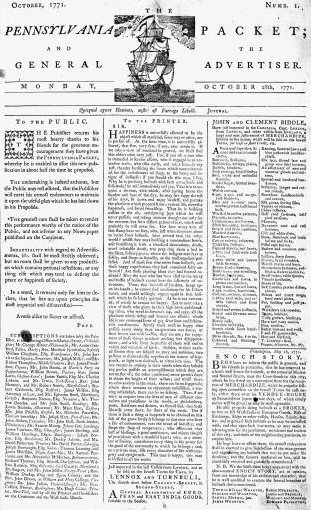
The Pennsylvania Packet - Facebook of the American Revolution
To the free and independent ELECTORS of the City of PHILADELPHIA.
. . The custom has been to deny the right of voting to all persons who have come from Germany, &c. until they have been naturalized, and taken such oaths as men now-a-days much object to; and what seems peculiar to this city alone, all men below the estate of fifty pounds are precluded. Now I must profess myself of the Forester’s opinion, that every man in the country who manifests a disposition to venture his all for the defence of its Liberty, should have a voice in its Councils. . . .
From an open letter published on April 29, 1776 in Dunlap's Pennsylvania Packet
In this day of protests and rebellions organized through Facebook and other online resources, we wonder how something like the American Revolution could have ever been organized and the word spread.
Every city in early America had a newpaper. These periodicals were small, usually 3 or 4 columns, only one page, and published at most a few times a week. They didn't have investigative reporters, but they would print just about any document brought in to them. These papers were delivered to those who could read and afford subscriptions, but were also read aloud in taverns and other gathering places.
In the 1770s, John Dunlap printed his Pennsylvania Packet three times a week. In 1780, he joined forces with David Claypoole who eventually took over publication. In 1784, the Packet became America's first daily newspaper.
Francis Hopkinson, signer of the Declaration, wrote many essays and poems for the Packet. His "Battle of the Kegs", a parody describing events of British-occupied Philadelphia, was published in March of 1778 and his tribute to General Washington, titled "A Toast" came out the next month.
"A Toast" can be heard on Colonial Revelers 1st CD, Revelry, Reflection & Revolution, along with "God Save Our Thirteen States," printed in the Pennsylvania Packet in 1779.
Your humble servants,
HH
Monday, September 26, 2011
October 2011 Events
(latest first)
Saturday, October 8, 9 am - 4 pm - FREE
Downingtown Friends Fall Festival
800 Lancaster Avenue
Downingtown, PA
Colonial Revelers will perform at noon - a lunchtime concert of songs popular between 1700 and 1800.
In 1774, John Downing donated land for the Lionville Friends to build a school. Friends around "Downing's Town" were granted permission to meet at the school in 1784. In 1806, Jenu Roberts donated land for the building of a meetinghouse for Downingtown Friends.
For more information about Downingtown Friends and this event, click here, phone 610-269-4223 or email info@downingtownfriendsmeeting.org
~~~~~~~~~~~~
Saturday, October 1, 10 pm - 4 pm - FREE
Newlin Mill Fall Festival
219 South Cheyney Rd
Glen Mills, PA
Colonial Revelers will perform two sets of period music at 11:30 am and 1:30 pm. Also on hand will be living history and craft demonstrations and tours of the house and mill.
Newlin Mill is the oldest operating grist mill in Pennsylvania. It was built by Nathaniel Newlin in 1704, the third mill built on the site by the Newlin family, who had come to America in 1683. The mill was run by the Newlins until 1817, then by other owners through 1941. A descendent of the Newlin family bought it in 1958 and began restoring it to its 18th century appearance. Besides the mill, this living history site has two houses, an office, a barn and a grain storage building.
For more information about the park, its history, and this event click here , email
info@newlingristmill.org or call 610-459-2359.
Saturday, October 8, 9 am - 4 pm - FREE
Downingtown Friends Fall Festival
800 Lancaster Avenue
Downingtown, PA
Colonial Revelers will perform at noon - a lunchtime concert of songs popular between 1700 and 1800.
In 1774, John Downing donated land for the Lionville Friends to build a school. Friends around "Downing's Town" were granted permission to meet at the school in 1784. In 1806, Jenu Roberts donated land for the building of a meetinghouse for Downingtown Friends.
For more information about Downingtown Friends and this event, click here, phone 610-269-4223 or email info@downingtownfriendsmeeting.org
~~~~~~~~~~~~
Saturday, October 1, 10 pm - 4 pm - FREE
Newlin Mill Fall Festival
219 South Cheyney Rd
Glen Mills, PA
Colonial Revelers will perform two sets of period music at 11:30 am and 1:30 pm. Also on hand will be living history and craft demonstrations and tours of the house and mill.
Newlin Mill is the oldest operating grist mill in Pennsylvania. It was built by Nathaniel Newlin in 1704, the third mill built on the site by the Newlin family, who had come to America in 1683. The mill was run by the Newlins until 1817, then by other owners through 1941. A descendent of the Newlin family bought it in 1958 and began restoring it to its 18th century appearance. Besides the mill, this living history site has two houses, an office, a barn and a grain storage building.
For more information about the park, its history, and this event click here , email
info@newlingristmill.org or call 610-459-2359.
Saturday, August 27, 2011
September 2011 Events
(latest first)
Sunday, September 18, Noon-4 pm
Stafford Heritage Picnic
Manahawkin Lake Park
49 West Bay Ave
(Rte 9 and Main Sts)
Manahawkin, NJ
Colonial Revelers will stroll around the lake and sing at this great multi-era living history event.
In the early part of the decade, Stafford Heritage Days took up a whole weekend and included a reenactment of the Battle of Cedar Bridge, the last engagement of the Revolution (darn those New Jersey loyalists!). Living history groups of all eras showed up, including colonial pirates, temperance ladies, a vintage baseball team, and the most eerily realistic General Grant, Chamberlain and Mr. and Mrs. Lincoln you'd ever want to meet. Then the recession hit, resources were limited and the project was put on hold. This year, we're glad to see a comeback. Come out and join us. It's always fun.
~~~~~~~~~~~
Sunday, September 11, 11 am - 3 pm
Battle of Brandywine Reenactment
Brandywine Battlefield
Rou
Chadds Ford, PA
Colonial Revelers will provide period music in the living history area whenever guns and cannons are silent.
The Battle of Brandywine took place on September 11, 1777 and was the largest battle of American Revolution, with Washington's forces numbering about 15,000 and the British with perhaps 17,000 troops. Washington held a decent position on the hills above the Brandywine Creek, but he was in a loyalist/pacifist neighborhood. Deliberate misinformation, poor communication, bad reconnaissance and inexperienced soldiers all contributed to the American defeat, yet they were able to retreat to Chester and regroup. The British were hampered by the heat of the day and the length of time they took to march around the American flank to ford the creek.
Come tour Washington's and Lafayette's Headquarters, view living history demonstrations, eat colonial food and, of course, hear Colonial Revelers sing.
Saturday, April 2, 2011
Francis Hopkinson (1737-1791)
Most Americans don't recognize the name of Francis Hopkinson. Some know enough to state that he was a signer of the Declaration of Independence. Beyond that, he's been more or less lost to history, but this patriot ranks right up there with Franklin, Jefferson, Hancock and Washington.
Hopkinson was born and died in Philadelphia, and lived part of his life in New Jersey, representing that colony in Congress. He was in the first graduating class of the College of Philadelphia (which merged with the University of Penn in 1791), then studied law. He also served on the committee that drafted the Articles of Confederation. Besides becoming a lawyer, statesman, and jurist, he's been described as "a mathematician, a chemist, a physicist, a mechanic, an inventor, a musician and a composer of music, a man of literary knowledge and practice, a writer of airy and dainty songs, a clever artist with pencil and brush and a humorist of unmistakable power" (Tyler, Literary History of the American Revolution).
It's as a writer and musician that we'll discuss him here. He is credited with being America's first secular poet-composer, having published his first song in 1759 at the age of 21. Hopkinson also became well-known for his essays, many of which were satirical, such as his "Typographical Method of conducting a Quarrel" and "Essay on White Washing."
He combined his songwriting and satires during the Revolution to produce works such as "The Treaty," "The New Roof: A Song for Federal Mechanics," and "The Battle of the Kegs." The latter song was set to Yankee Doodle and comically described an incident that took place in January of 1779, when the British occupied Philadelphia. The Continental forces were experimenting with floating mines made from powder kegs. They sent them down river toward the city in an attempt to damage the British ships docked there. Redcoats were dispatched to shoot at the kegs, to set them off before they could do harm. Hopkinson's song told of the brave British troops valiantly waging war against the kegs. Here's a verse:
About the same time, Hopkinson wrote a tribute to Washington entitled "A Toast."
As always, your humble servants,
HH
Hopkinson was born and died in Philadelphia, and lived part of his life in New Jersey, representing that colony in Congress. He was in the first graduating class of the College of Philadelphia (which merged with the University of Penn in 1791), then studied law. He also served on the committee that drafted the Articles of Confederation. Besides becoming a lawyer, statesman, and jurist, he's been described as "a mathematician, a chemist, a physicist, a mechanic, an inventor, a musician and a composer of music, a man of literary knowledge and practice, a writer of airy and dainty songs, a clever artist with pencil and brush and a humorist of unmistakable power" (Tyler, Literary History of the American Revolution).
It's as a writer and musician that we'll discuss him here. He is credited with being America's first secular poet-composer, having published his first song in 1759 at the age of 21. Hopkinson also became well-known for his essays, many of which were satirical, such as his "Typographical Method of conducting a Quarrel" and "Essay on White Washing."
He combined his songwriting and satires during the Revolution to produce works such as "The Treaty," "The New Roof: A Song for Federal Mechanics," and "The Battle of the Kegs." The latter song was set to Yankee Doodle and comically described an incident that took place in January of 1779, when the British occupied Philadelphia. The Continental forces were experimenting with floating mines made from powder kegs. They sent them down river toward the city in an attempt to damage the British ships docked there. Redcoats were dispatched to shoot at the kegs, to set them off before they could do harm. Hopkinson's song told of the brave British troops valiantly waging war against the kegs. Here's a verse:
The royal band now ready stand,
All ranged in dread array, sir,
With stomachs stout to see it out,
And make a bloody day, sir.
The cannons roar from shore to shore,
The small arms make a rattle;
Since wars began, I'm sure no man
E'er saw so strange a battle.
About the same time, Hopkinson wrote a tribute to Washington entitled "A Toast."
'Tis Washington's Health,
Fill a bumper around,
For he is our glory and pride;
Our arms shall in battle with
Conquest be crowned,
Whilst virtue and
He's on our side.
"A Toast" can be heard on Colonial Revelers CD Revelry, Reflection and Revolution. See our website for details.
As always, your humble servants,
HH
Tuesday, January 25, 2011
'Tis Washington's Health!
Join Colonial Revelers
in a celebration of the General's Birthday!
Where: Valley Forge National Historical Park
Welcome Center
When: Monday, February 21 - 11 am to 3 pm
Welcome Center
When: Monday, February 21 - 11 am to 3 pm
Valley Forge National Historical Park will present special programs all weekend, beginning Saturday, February 19 at 8 am. This will be the 99th year that the Boy Scouts of America will camp at the park. Other events include artillery, rifle, musket and medical demonstrations, programs on camp life, African-American regiments and contributions by the Oneida Indian Nation to the cause of Independence.On Monday, the 21st, visitors will be able to meet the General and his wife at the Welcome Center, listen to music by the Colonial Revelers, and participate in children's activities. Martha Washington's original recipe Great Cake will be served. For more information, go to the park's event page.
Many songs were written about General Washington during the Revolution. Here is one of Colonial Revelers' favorites, penned by Francis Hopkinson (signer of the Declaration of Independence), and first published April 8, 1778 in the Pennsylvania Packet.
A Toast
'Tis Washington's Health, fill a bumper around,
For he is our glory and pride;
Our arms shall in battle with conquest be crowned
Whilst virtue and he's on our side.
'Tis Washington's health, loud cannons should roar
And trumpets the truth should proclaim;
There cannot be found, search all the world o'er,
His equal in virtue and fame.
'Tis Washington's health, our hero to bless,
May heaven look graciously down;
Oh! long may he live, our hearts to possess,
And Freedom still call him her own.
This song can be heard on our first CD: REVELRY, REFLECTION & REVOLUTION .
Your humble servants,
HH
Wednesday, December 29, 2010
'Tis The Season
now 1787 is Ended,
it happy is if we are mended,
God grant if not we may be.
Martha Ballard's diary, December 31, 1787
it happy is if we are mended,
God grant if not we may be.
Martha Ballard's diary, December 31, 1787
Before the 19th century, Christmas was a minor religious holiday. Many Christian sects didn't celebrate it at all, partly because the actual day wasn't specified in the Bible, and also, as the Puritans put it, the season promoted drinking and debauchery. (The Puritans, in fact, outlawed Christmas.) Most stores and markets were open on the 25th. At first, only Catholics held services. Protestant churches joined in after many of their congregants began attending the Catholic masses to hear the special music of the day.
How was the season observed? The wealthy threw elaborate dinner parties. Poorer classes, knowing the rich were congregating for the Yule, went door-to-door, asking for money or food and drink in return for a wassail (that is, a toast to the health of the host and his family, often sung). Servants and workers were given coins by their employers and patrons. Some people observed customs brought over from Europe--mistletoe, the making of mince pies, a Yule log, perhaps modest decoration of the mantel with things like leaves, pine cones, or a few apples, to be eaten during the season. No one would have wasted food, let alone something like a pineapple, which very few could afford, by nailing it over the door. A poor man would have stolen the fruit before the night was out, to feed his family. In the taverns, a bowl of special punch might be prepared. And now that the harvest was done, if the roads were frozen enough for mudless travel, visiting neighbors and relatives was common. Time to hear stories (ghost tales were popular in the long nights), to sing and catch up on news and gossip.
Most Americans now consider Thanksgiving through December 25th as the Christmas season, but that's a recent development, defined by 20th century merchants. Traditionally, Yuletide is December 25th through January 6th (Epiphany--the day the Magi visited Christ). In early America, since many people were farmers whose calendars were determined by the solstices and equinoxes, Yuletide began for some on December 21.
January 6th--also called "Old Christmas"--was the 12th day of the Yuletide (you know, 12 drummers drumming?). Both its eve and the night of Epiphany have been called Twelfth Night. In colonial America, Twelfth Night was a traditional time for weddings, and for a final party before the Yule came to a close.
As for music, many lyrics of our traditional carols, such as Joy To The World, Hark, the Herald Angels Sing, and While Shepherds Watched Their Flocks by Night, were sung to earlier tunes. The American composer Williams Billings wrote several fun-to-sing Christmas songs, including A Virgin Unspotted and Methinks I See A Heavenly Host. And of course, the wassails mentioned above were very popular, most using some variation of the words
God bless the Master of this House
The Mistress also
And all the little children
That 'round the table go.
The Mistress also
And all the little children
That 'round the table go.
One of Historical Harmonies favorite Yuletide songs is the shape-note hymn Milford, which was published in 1802 and most often attributed to James Stephenson. In the video, Colonial Reveler tenor Jason Gagliardi performs all 4 parts. We hope you enjoy it.
Happy Yuletide to all!
Your humble servants,
HH
Tuesday, November 30, 2010
Now We Are Met - Rounds & Canons
No music is so satisfying as the singing of a round. Everyone gets to sing the melody, yet the harmonies can be as full and beautiful as a large chorus.
The harmonies of a round result when different voices begin and end the melody at different times. If the voices begin at different times yet end together on a final chord, the song is called a canon. Rounds and canons were very popular in the 17th and 18th centuries, and in a variety of settings--from William Billings's sacred "When Jesus Wept" to Henry Purcell's bawdy "I Gave Her Cakes." They can be as long as a full verse of a song, or as short as 2 or 3 phrases. Colonial Revelers begins each of their concerts with the round "Now We Are Met," composed by Samuel Webbe (1740-1816), as heard in the video above.
The easiest way to learn a round is to sing one part over and over until you've got it, then move on to the 2nd part, then the 3rd. You might, for instance, sing only "Row, row, row your boat," over and over, while your friends sing all the way through the round. Next time you'd sing "Gently down the stream," until you're sure of those notes. Then "Merrily, merrily, merrily, merrily," and so forth. Eventually, you've got the whole melody.
Some of Colonial Revelers' favorite rounds and canons:
Now We Are Met (Webbe, late 18th century)
Sweet Sir Walter (Purcell, 1733)
I Gave Her Cakes (Purcell, 1731)
He That Will an Alehouse Keep (Ravenscroft, 1611)
Banberry Ale (Ravenscroft, 1609)
Christchurch Bells (Aldrich, 1673)
The Sports of May (Warren, 1775)
When Jesus Wept (Billings, 1770)
Canon (Billings, 1770)
You can hear these rounds on either the Down Among the Deadmen or Revelry, Reflection & Revolution CDs.
As ever, your humble servants,
HH
Saturday, November 13, 2010
DECEMBER EVENTS
We must not omit here to thank the Publick for the gracious and
kind Encouragement they have hitherto given us.
Poor Richard's Almanack, 1737, paraphrased
Saturday, December 4, 11 am - 3 pm

The Mill at Anselma
1730 Conestoga Road
Chester Springs, PA 19425
Our Victorian Carolers ensemble will regale vistors to the mill with traditional holiday songs from Charles Dickens's England.
Anselma Mill on Pickering Creek was operated as a grist mill from 1725 to 1982 and retains its original Colonial era power train. In 1982, the French and Pickering Creeks Conservation Trust took over the property who did some early restoration and stabilize the buildings. In 1998, a new organization, The Mill at Anselma Preservation and Educational Trust began a full restoration. In 2005, the Mill at Anselma was designated a National Historic Landmark. Today, it's the most complete known example of a custom grain mill in the United States.
For further information about the mill or this event, call them at 610-827-1906, email info@anselmamill.org or click here for their website.
______
Saturday, December 4, 4-7 pm
"Deck the Alley"
Elfreth's Alley
2nd St., between Race & Arch Sts.
Philadelphia, PA
After enjoying Victorian Carolers at Anselma Mill, head down to Olde City Philadelphia, where Colonial Revelers will be strolling along Elfreth's Alley, singing 18th century holiday carols, wassail songs, and other music of the period.
Elfreth's Alley has been a residential street continuously since 1702. The 32 houses there today were built between 1720s and 1830s. The alley is a National Historic Landmark District. Numbers 124 and 126 are open to the public year-round as a museum of life in early Philadelphia. Guidebooks and cellphone tours of the alley are available.
During the "Deck the Alley" event, many of the narrow street's residents open their houses for tours. Refreshments will be available. For ticket information about the events, call 215-574-0560 or click here for their website.
_______
Saturday, December 11, 4-6 pm
Village of Marshallton
559 Northbrook Rd
West Chester, PA 19382
Colonial Revelers will return to Martin's Tavern to provide holiday music for the lighting of the village tree.
As stated last month, Martin's Tavern, also called Center House, was built in 1764. The inn played a prominent role during the Battle of Brandywine in 1777. The restored ruins of the tavern form Marshallton's village square, where a large evergreen tree is decorated with lights each year. Refreshments will be served. Find out about Martin's Tavern events: http://taproom.martinstavern.org/
_________
Sunday, December 19, 6-8 pm
The "March-In"
Valley Forge National Historical Park
1400 N. Outer Line Dr.
Valley Forge PA 19406
Colonial Revelers will be stationed in the Visitor Center, singing 18th century wassail songs, Christmas hymns and other period music to commemorate the day the Continental Army arrived at Valley Forge in 1777. Come for the party!
Valley Forge National Historical Park is the site of the Continental Army's winter encampment, from December 19, 1777 to June 19, 1778. Park rangers and Friends of Valley Forge will be on hand for candlelight tours, a "march" up to Muhlenberg's huts, and other 18th century festivities. Refreshments, holiday shopping and free gift wrapping will be available at the Encampment Store at the Visitor Center. Free and open to the public. Information and directions at http://www.nps.gov/vafo/planyourvisit/events.htm
Your humble servants,
HH
Monday, September 13, 2010
Colonial Revelers Events
We of Colonial Revelers are yet again pleased to present our music at some of the Delaware Valley's most historic venues.
Our calendar for
October, 2010:

Time: 10-4 -- FREE
In this historic setting, Colonial Revelers will present concerts at 11:30 and 1:30. We'll stroll around singing the rest of the time.
Newlin Mill is the oldest operating grist mill in Pennsylvania. It was built by Nathaniel Newlin in 1704, the third mill built on the site by the Newlin family, who had come to America in 1683. The mill was run by the Newlins until 1817, then by other owners through 1941. A descendent of the Newlin family bought it in 1958 and began restoring it to its 18th century appearance. Besides the mill, this living history site has two houses, an office, a barn and a grain storage building.
For more information about the park, its history, and this event click here , email info@newlingristmill.org or call 610-459-2359.

Colonial Revelers will present a concert at noon. Homemade soups, chili, funnel cake and other foods will be available for purchase. Come for lunch and music!
In 1774, John Downing donated land for the Lionville Friends to build a school. Friends around "Downing's Town" were granted permission to meet at the school in 1784. In 1806, Jenu Roberts donated land for the building of a meetinghouse for Downingtown Friends.
For more information about Downingtown Friends and this event, click here , phone 610-269-4223 or email info@downingtownfriendsmeeting.org
Martin's Tavern, also called Center House, was built in 1764. The inn played a prominent role during the Battle of Brandywine in 1777. Much of the original tavern was lost over the years, but the ruins were restored and form the centerpiece of Marshallton's public square (really more of a triangle).
Click here for a look at last year's poster, which will give you an idea what to expect.
Find out about the Friends of Martin's Tavern: http://www.martinstavern.org/
For more information, contact West Bradford Township at 610-269-4174.
Your humble servants,
HH
Our calendar for
October, 2010:
Saturday the 2nd
Fall Harvest Festival at
Newlin Grist Mill Park
219 South Cheyney Road
Glen Mills, PA 19342
Newlin Grist Mill Park
219 South Cheyney Road
Glen Mills, PA 19342

Time: 10-4 -- FREE
In this historic setting, Colonial Revelers will present concerts at 11:30 and 1:30. We'll stroll around singing the rest of the time.
Newlin Mill is the oldest operating grist mill in Pennsylvania. It was built by Nathaniel Newlin in 1704, the third mill built on the site by the Newlin family, who had come to America in 1683. The mill was run by the Newlins until 1817, then by other owners through 1941. A descendent of the Newlin family bought it in 1958 and began restoring it to its 18th century appearance. Besides the mill, this living history site has two houses, an office, a barn and a grain storage building.
For more information about the park, its history, and this event click here , email info@newlingristmill.org or call 610-459-2359.
* * *
Saturday the 9th
Downingtown Friends Meeting
Fall Festival
800 East Lancaster Avenue
Downingtown, PA 19335
Downingtown Friends Meeting
Fall Festival
800 East Lancaster Avenue
Downingtown, PA 19335
Time: 9-4 -- FREE
Colonial Revelers will present a concert at noon. Homemade soups, chili, funnel cake and other foods will be available for purchase. Come for lunch and music!
In 1774, John Downing donated land for the Lionville Friends to build a school. Friends around "Downing's Town" were granted permission to meet at the school in 1784. In 1806, Jenu Roberts donated land for the building of a meetinghouse for Downingtown Friends.
For more information about Downingtown Friends and this event, click here , phone 610-269-4223 or email info@downingtownfriendsmeeting.org
* * *
Saturday the 23rd
Marshallton Ghost Walk & Family Fun Night
Village of Marshallton
559 Northbrook Rd
West Chester, PA 19382
Marshallton Ghost Walk & Family Fun Night
Village of Marshallton
559 Northbrook Rd
West Chester, PA 19382
Time: 5-8 pm -- FREE
Colonial Revelers will sing throughout the evening at the historic ruins of Martin's Tavern. Friends of Martin's Tavern will provide hot cider, cookies and other food. The event involves the whole town, including all kinds of activities for kids, so park at the United Methodist Church at 1282 W. Strasburg Road and follow the signs.
Click here for a look at last year's poster, which will give you an idea what to expect.
Find out about the Friends of Martin's Tavern: http://www.martinstavern.org/
For more information, contact West Bradford Township at 610-269-4174.
Your humble servants,
HH
Sunday, August 1, 2010
Methinks One Tooth is Dry
Give me yesterday's Bread, this Day's Flesh, and last Year's Cyder.
Poor Richard's Almanac, 1744
On 23 August 1775, King George III declared the American colonies to be in "open and avowed Rebellion" and issued a "Proclamation For suppressing Rebellion and Sedition."
Yet at the time General Washington had other than Rebellion on his mind. An epidemic of dysentery raged through his camp. As this coincided with the pressing of the first apple harvest, he made the connection and issued his own Proclamation:
"As nothing is more pernicious to the health of Soldiers, nor more certainly productive of the bloody-flux; than drinking New Cyder: The General in the most possitive manner commands, the entire disuse of the same..."
George Washington, August 28, 1775
Cyder in the 18th century meant unfiltered hard cider--a popular and very common drink. (If you wanted it with no alcohol, you requested sweet cider.) Every farm and estate in America (and England) had an apple orchard, and nearly everyone else with a bit of ground near their houses kept a few apple trees. Communities had cider mills where you could bring your apples to be pressed if you couldn't do it yourself.
So it's interesting that the drinking songs of the era, while extolling the virtues of beer, wine and whisky, fail to mention cider. Perhaps because after beer or wine, at least, you can still hold a quill to write a song.
Still, each New Year the apple trees were blessed so they'd bring a good harvest in August, along with the assurance of cider to last the winter through.
As for General Washington's dilemma, he'd likely have done better to forbid the drinking of water.
TRUDGE away quickly and fill the black bole,
Devoutly as long as wee bide,
Now welcome, good fellows, both strangers and all,
Let madness and mirth set sadness aside.
Masters, this is all my desire,
I would no drink should pass us by;
Let us now sing and mend the fire,
For still me thinks one tooth is drye.
from Thomas Ravenscroft's A Brief Discourse, 1614
Devoutly as long as wee bide,
Now welcome, good fellows, both strangers and all,
Let madness and mirth set sadness aside.
Masters, this is all my desire,
I would no drink should pass us by;
Let us now sing and mend the fire,
For still me thinks one tooth is drye.
from Thomas Ravenscroft's A Brief Discourse, 1614
(This song can be heard on Colonial Revelers'
Your humble servants,
HH
Thursday, July 1, 2010
Williams Billings & Independence
When in the Course of human events, it becomes necessary for one people to dissolve the political bands which have connected them with another...a decent respect to the opinions of mankind requires that they should declare the causes which impel them to the separation.
DECLARATION OF INDEPENDENCE, July 4, 1776
Upon this both solemn and happy Occasion of the Anniversary of our Independence, Colonial Revelers is pleased to perform Music by Mr. William Billings at St. Matthews United Methodist Church of Valley Forge on July Fourth, at half past nine in the Morning.
Mr. William Billings grew up in Boston, poor and uneducated, untidy in dress, described by some as a gargoyle, due to a short leg, a withered arm, and one blind eye. He became a tanner, yet also took up music at a young age and taught choral singing by the age of 22.
At age 24, he published "The New-England Psalm-Singer," a collection of choral works, and the first book of entirely American music. His friend Paul Revere engraved the book's frontispiece. Five more volumes followed. Within 30 years, Mr. Billings's music had become vastly popular and he was able to earn his bread and butter as a composer, the first American to do so.
His music combines traditional sacred hymn and classical styles, the new American choral-singing movement, and his own political fervor. His hymn "Chester" was considered the original National Anthem.
"I think it best for every composer to be his own carver."
William Billings
William Billings
Your humble servants,
HH
Subscribe to:
Posts (Atom)