Join the ensembles of Historical Harmonies this month as we celebrate the holiday season.
Friday, December 5
6 -9 pm
HOLIDAY CELEBRATION
Limerick Community Park
Swamp Pike & Ziegler Road
Limerick, PA
Victorian Carolers will perform holiday carols at this free event. Crafts, hot cocoa and cookies, and of course, Santa Claus. Bring a new unwrapped toy for Toys For Tots.
Saturday, December 6
3-7 pm
DECK THE ALLEY!
Elfreth's Alley Museum
Elfreth's Alley, Philadelphia, PA
Colonial Revelers will sing and perform antics on the oldest residential street in the U.S. as the neighbors open their colonial era homes to the public.
Unique holiday decorations, refreshments, carriage rides, story tellers,
authentic 18th Century mummers, as well as encounters with Ben
Franklin, Dolley Madison and colonial Pennsylvania’s own cranky Santa
“Belsnickel” himself.
Tickets are $25 for adults, $10 for children. Group rates available. Tickets at https://elfrethsalley.ticketleap.com/deck-the-alley-2014/dates/Dec-06-2014_at_0300PM
Friday, December 19
5:30-7 pm
THE "MARCH-IN" at VALLEY FORGE
Valley Forge National Historical Park
1400 North Outer Line Drive
Valley Forge, PA
Colonial Revelers will be stationed in the Visitor Center, singing 18th century wassail songs, Christmas hymns and other period music to commemorate the day the Continental Army arrived at Valley Forge in 1777. Come for the party!
Valley Forge National Historical Park is the site of the Continental Army's winter encampment, from December 19, 1777 to June 19, 1778. Park rangers and Friends of Valley Forge will be on hand for candlelight tours, a "march" up to Muhlenberg's huts, and other 18th century festivities. Refreshments, holiday shopping and free gift wrapping will be available at the Encampment Store at the Visitor Center. Free and open to the public.
Sunday, December 21
7-9 pm
COMMUNITY SOLSTICE SING
The Birdhouse Center for the Arts
7 North Main, Lambertville, NJ
Members of Historical Harmonies will add their voices and flair for mischief to the mix to celebrate the shortest day. Bring your favorite songbooks, instruments, drinks/food and friends for a cozy evening of community celebration! Refreshments provided but additional snacks and beverages welcome.
Tickets: $5 individual or $10 whole family. Seating is first come, first served.
The Birdhouse will also have free Morris Dancing in the afternoon from 4-6 pm.
Welcome Yule !
Historical Harmonies and Colonial Revelers bids you welcome! Here you'll find news of our events, as well as historical information about our music and the periods of history where you might have first heard it sung. Charge your glasses and make yourself comfortable by the fire.
Monday, December 1, 2014
Thursday, September 18, 2014
Colonial Revelers October Events
October is Harvest Festival time! Come hear Colonial Revelers at the following events:
Newlin Grist Mill Fall Harvest Festival
Saturday, October 4
10 am to 4 pm
219 Cheyney Rd (at Route 1)
Glen Mills, PA
Newlin Grist Mill was built in 1704 and operated commercially until 1941. Now it's a historic site and park. At their fall festival, the 18th century comes alive with the sights, sounds, and smells of colonial America. Tradesmen and artisans will demonstrate papermaking, colonial brewing, iron making, brickmaking, blacksmithing, historic baking, and milling throughout the day. Displays include bee skeps, colonial money, and chair caning. Stop by to see a dairy cow, heritage sheep, and chickens. Listen to colonial music, learn period dancing, play colonial games, decorate a pumpkin, and enjoy a hayride through the 160-acre grounds. Colonial Revelers will sing 2 sets, at about 11 am and 1 pm, right out in front of the house. You can't miss us.
Admission is free. Parking is $5 per car. More information at http://www.newlingristmill.org/#!fall-harvest-festival/c1m63
________________________
Downingtown Friends Meeting Fall Festival
Saturday, October 11
9 am to 4 pm
800 East Lancaster Ave.
Downingtown, PA
Colonial Revelers will perform for the lunch crowd at noon, and this year by special request, we'll be adding in a few of our 19th century seasonal songs into our mix of colonial church hymns, tavern songs and tunes from the Revolution.
Also at the festival you'll find craft vendors, live folk and rock music, Downingtown's famous Festival foods (their vegetarian chili is amazing!), and serious garage-sale finds at the Friends Mercantile. You'll be able to learn about the history of Downingtown Friends from the Quaker Heritage Exhibit inside, featuring antique Quaker clothing and memorabilia. At 1:30 pm, in authentic early American Quaker garb, the Friends will reenact the first wedding that took place at the meetinghouse in 1806. For the kids, they offer children’s crafts and games. There’s also a hay wagon ride and exceptional face painting for both kids and adults.
Admission and parking are free. Park across Lancaster Avenue. More info at http://downingtownfriendsmeeting.org/fallfestival.htm
Newlin Grist Mill Fall Harvest Festival
Saturday, October 4
10 am to 4 pm
219 Cheyney Rd (at Route 1)
Glen Mills, PA
Newlin Grist Mill was built in 1704 and operated commercially until 1941. Now it's a historic site and park. At their fall festival, the 18th century comes alive with the sights, sounds, and smells of colonial America. Tradesmen and artisans will demonstrate papermaking, colonial brewing, iron making, brickmaking, blacksmithing, historic baking, and milling throughout the day. Displays include bee skeps, colonial money, and chair caning. Stop by to see a dairy cow, heritage sheep, and chickens. Listen to colonial music, learn period dancing, play colonial games, decorate a pumpkin, and enjoy a hayride through the 160-acre grounds. Colonial Revelers will sing 2 sets, at about 11 am and 1 pm, right out in front of the house. You can't miss us.
Admission is free. Parking is $5 per car. More information at http://www.newlingristmill.org/#!fall-harvest-festival/c1m63
________________________
Downingtown Friends Meeting Fall Festival
Saturday, October 11
9 am to 4 pm
800 East Lancaster Ave.
Downingtown, PA
Colonial Revelers will perform for the lunch crowd at noon, and this year by special request, we'll be adding in a few of our 19th century seasonal songs into our mix of colonial church hymns, tavern songs and tunes from the Revolution.
Also at the festival you'll find craft vendors, live folk and rock music, Downingtown's famous Festival foods (their vegetarian chili is amazing!), and serious garage-sale finds at the Friends Mercantile. You'll be able to learn about the history of Downingtown Friends from the Quaker Heritage Exhibit inside, featuring antique Quaker clothing and memorabilia. At 1:30 pm, in authentic early American Quaker garb, the Friends will reenact the first wedding that took place at the meetinghouse in 1806. For the kids, they offer children’s crafts and games. There’s also a hay wagon ride and exceptional face painting for both kids and adults.
Admission and parking are free. Park across Lancaster Avenue. More info at http://downingtownfriendsmeeting.org/fallfestival.htm
Sunday, April 28, 2013
Bring In The May!
This year, our May Revelers will partner with the Birdhouse Center for the Arts to properly usher in the May in Lambertville, NJ.
Join us on Saturday, May 4 at 1 pm. Learn songs and dances associated with a traditional May Day celebration! The event is free and open to the public.
The Revelers, dressed in English country costume, will sing a variety of seasonal English and Celtic songs. The dances have their roots mostly in Morris and English Country dance traditions, though one annual favorite, La Bastringue, hails from French Canada. And, of course, the group will perform the quintessential Maypole dance. Interested audience members will be given a chance to learn the dances and participate.
The Birdhouse Center is located at 7 North Main St. in Lambertville. From the Delaware River, follow Bridge St. about a quarter mile inland to Main. Turn left on Main. The first drive on the left will lead you back to the Birdhouse. Since we will be performing in their parking lot, please park out on the street.
Join us on Saturday, May 4 at 1 pm. Learn songs and dances associated with a traditional May Day celebration! The event is free and open to the public.
The Revelers, dressed in English country costume, will sing a variety of seasonal English and Celtic songs. The dances have their roots mostly in Morris and English Country dance traditions, though one annual favorite, La Bastringue, hails from French Canada. And, of course, the group will perform the quintessential Maypole dance. Interested audience members will be given a chance to learn the dances and participate.
The Birdhouse Center is located at 7 North Main St. in Lambertville. From the Delaware River, follow Bridge St. about a quarter mile inland to Main. Turn left on Main. The first drive on the left will lead you back to the Birdhouse. Since we will be performing in their parking lot, please park out on the street.
Monday, September 24, 2012
October 2012 Events
(latest first)
Saturday, October 13, 2012
9 am to 4 pm
800 E. Lancaster Ave.
Downingtown, PA 19335
Colonial Revelers will sing a concert of 18th century music at noon. Besides the music on the mainstage, the Festival offers delicious foods, children's activities, plants, crafts, and white-elephant sales, all on the grounds of this beautiful historic meeting house. At 1:30 is the annual authentic reenactment of an 1806 Quaker wedding.
Admission is free and so is the parking, across the street. For more information and directions, go to Downingtown Friend's Festival page.
~~~~~~~~~~~~~~~~~~.
Saturday, October 6, 2012
10 am to 4 pm
219 South Cheyney Rd (Routes 1 and 322)
Glen Mills, PA 19342
Colonial Revelers will perform at 11 am and 1 pm. In between you can listen to period harp and mandolin music as you stroll around the grounds, meeting over 20 living history demonstrators plying colonial crafts and trades such as spinning, blacksmithing, brick making, and weaving. Colonial meals will be prepared over open hearths and you can watch the mill in action.
This event is free of charge. Go to Newlin Mill's site for more information and directions.
Saturday, October 13, 2012
9 am to 4 pm
Downingtown Friends Meeting Fall Festival
Downingtown Friends Meeting 800 E. Lancaster Ave.
Downingtown, PA 19335
Colonial Revelers will sing a concert of 18th century music at noon. Besides the music on the mainstage, the Festival offers delicious foods, children's activities, plants, crafts, and white-elephant sales, all on the grounds of this beautiful historic meeting house. At 1:30 is the annual authentic reenactment of an 1806 Quaker wedding.
Admission is free and so is the parking, across the street. For more information and directions, go to Downingtown Friend's Festival page.
~~~~~~~~~~~~~~~~~~.
Saturday, October 6, 2012
10 am to 4 pm
Newlin Grist Mill Fall Harvest Festival
Newlin Grist Mill219 South Cheyney Rd (Routes 1 and 322)
Glen Mills, PA 19342
Colonial Revelers will perform at 11 am and 1 pm. In between you can listen to period harp and mandolin music as you stroll around the grounds, meeting over 20 living history demonstrators plying colonial crafts and trades such as spinning, blacksmithing, brick making, and weaving. Colonial meals will be prepared over open hearths and you can watch the mill in action.
This event is free of charge. Go to Newlin Mill's site for more information and directions.
Friday, September 14, 2012
September 2012 Events
(latest first)
Saturday, September 22, 2012
9 am to 5 pm
Montgomery County History Fair
Augustus Lutheran Church717 West Main St.
Trappe, PA
Colonial Revelers, in costume, will provide music for this unique living history experience. More than 30 historical societies, living history and civic organizations will be present, plus food and other vendors.
For more information, go to the W.S. Hancock Society web page.
~~~~~~~~~~~~~~~~~~~
Sunday, September 16, 2012 9:30 am to 11 am
St. Thomas Church History Day
St. Thomas Church, Whitemarsh
Bethlehem Pike and Camp Hill Rds
Fort Washington, PA
Colonial Revelers will sing at the end of the 9:30 service, then downstairs for a signing of a book about the church's history.
For more info, go to St. Thomas's site.
Wednesday, July 25, 2012
We Love A Parade
"...in passing thro' the City...great attention given by the officers to see that the men carry their arms well, and are made to appear as decent as circumstances will admit."
Washington's orders, Aug. 23, 1777
On August 24, 1777, Front Street in Philadelphia was the site of a Grand Parade of the Continental Army. The troops were on their way south, to defend the city from the British who were landing along the Chesapeake. Washington decided to take advantage of the situation to flaunt his troops, hoping to win support from the citizens. He took the precaution of sending some of the sutlers and less reputable camp followers (i.e. whores) down to Delaware by another route.
The word "parade"--coined in the 17th century--originally meant to prepare and was used in a military context. Parade grounds were places for troops to practice maneuvers and eventually to display the troops abilities to superior officers and important visitors. This sort of formal, ceremonial marching came to be known in itself as a parade. If the troops were cavalry, it was called a cavalcade.
In the 18th century, "parades" were always military. Civilians held processions or promenades, for weddings, funerals, religious feasts, and holidays like May Day.
By the mid-19th century, the distinctions began to fade. After the Civil War, veterans groups and Ladies Auxiliaries joined military parades held in cities and towns for holidays. Civic bands joined in, then Temperance Leagues, Scout troops, school bands, athletes and cheerleaders. As towns acquired fancy new equipment for their fire and police departments, they'd shine them up to show off to the spectators. And, naturally, all the local politicians would be in attendance, dressed up in their best and waving flags.
Parade floats supposedly got their start in the Middle Ages, when traveling passion plays put their scenery on horse wagons. The name "float" came from the decorated barges on the Seine during the Lord Mayor's Show, a public holiday in London. And, of course, traveling circuses also used floats to arouse interest in their shows. After World War II, even the military used floats, topped by large cannons and missiles.
This past July 4th, we in Colonial Revelers walked in our first parade. In front of us were County Sheriff Department vehicles. Behind were kids from the local Tai Kwan Do school. The parade included all the traditional participants--high school band, church groups, fire trucks--but also motorcycle clubs, and even a paranormal investigation team.
The best thing about the parade were all the spectators, people from all races, religions and walks of life, all smiling, cheering and waving American flags. We discovered that day that the parade in America had evolved into something that brought everyone together.
Looking forward to next year.
Your obedient servants,
HH
Washington's orders, Aug. 23, 1777
On August 24, 1777, Front Street in Philadelphia was the site of a Grand Parade of the Continental Army. The troops were on their way south, to defend the city from the British who were landing along the Chesapeake. Washington decided to take advantage of the situation to flaunt his troops, hoping to win support from the citizens. He took the precaution of sending some of the sutlers and less reputable camp followers (i.e. whores) down to Delaware by another route.
The word "parade"--coined in the 17th century--originally meant to prepare and was used in a military context. Parade grounds were places for troops to practice maneuvers and eventually to display the troops abilities to superior officers and important visitors. This sort of formal, ceremonial marching came to be known in itself as a parade. If the troops were cavalry, it was called a cavalcade.
In the 18th century, "parades" were always military. Civilians held processions or promenades, for weddings, funerals, religious feasts, and holidays like May Day.
By the mid-19th century, the distinctions began to fade. After the Civil War, veterans groups and Ladies Auxiliaries joined military parades held in cities and towns for holidays. Civic bands joined in, then Temperance Leagues, Scout troops, school bands, athletes and cheerleaders. As towns acquired fancy new equipment for their fire and police departments, they'd shine them up to show off to the spectators. And, naturally, all the local politicians would be in attendance, dressed up in their best and waving flags.
Parade floats supposedly got their start in the Middle Ages, when traveling passion plays put their scenery on horse wagons. The name "float" came from the decorated barges on the Seine during the Lord Mayor's Show, a public holiday in London. And, of course, traveling circuses also used floats to arouse interest in their shows. After World War II, even the military used floats, topped by large cannons and missiles.
The best thing about the parade were all the spectators, people from all races, religions and walks of life, all smiling, cheering and waving American flags. We discovered that day that the parade in America had evolved into something that brought everyone together.
Looking forward to next year.
Your obedient servants,
HH
Monday, April 23, 2012
Upcoming Events
for the end of April, beginning of May (latest one first):
Saturday, May 5, 2012 11:25-11:55 am
Dekalb and Main Sts.
Norristown, PA 19401
Colonial Revelers will perform songs of early America in costume.
The Norristown Arts Hill Festival goes from 10 am to 5 pm and includes performers in theater, dance, poetry, and all kinds of music. Vendors will be on hand selling food, crafts, and arts-related items. For info, go to www.norristownartshill.org.
~~~~~~~~~~~~~~~~~~~
Thursday, April 26, 2012 5:15-6 pm
Montgomery County-Norristown Public Library
Powell and Swede Sts.
Norristown, PA 19401
Colonial Revelers will perform as people gather for the library's One Book-One Norristown event, with author Jerry Spinelli, which will begin at 6 pm. Come early to hear us sing songs popular in the year of Norristown's founding, 1812.
Visit the library website for more info: http://www.mc-npl.org/index.html
Saturday, May 5, 2012 11:25-11:55 am
Norristown Arts Hill Festival
Main StageDekalb and Main Sts.
Norristown, PA 19401
Colonial Revelers will perform songs of early America in costume.
The Norristown Arts Hill Festival goes from 10 am to 5 pm and includes performers in theater, dance, poetry, and all kinds of music. Vendors will be on hand selling food, crafts, and arts-related items. For info, go to www.norristownartshill.org.
~~~~~~~~~~~~~~~~~~~
Thursday, April 26, 2012 5:15-6 pm
Montgomery County-Norristown Public Library
Powell and Swede Sts.
Norristown, PA 19401
Colonial Revelers will perform as people gather for the library's One Book-One Norristown event, with author Jerry Spinelli, which will begin at 6 pm. Come early to hear us sing songs popular in the year of Norristown's founding, 1812.
Visit the library website for more info: http://www.mc-npl.org/index.html
Tuesday, April 10, 2012
Washington, the Father of Election Freebies
| William Hogarth's "An Election Entertainment" |
In 1757, he decided to run for office again. This time he tried something different. To the polling booth in his district, he brought "a barrel of punch, 35 gals. of wine, 43 gals. of strong cider and dinner." It cost him 39 pounds, 6 shillings (about $6500 in today's money).
He won the election.
But the Virginia Assembly of 1699 had passed a law forbidding candidates from giving voters "money, meat, drink, or provisions" for the purpose of procuring votes. As a result of Washington's polling place buffet, the House of Burgesses further shored up the old rule by saying candidates could be disqualified for such acts.
Nevertheless, a lot of his fellow politicians took note of Washington's success and argued against the rule. At the time, voters (i.e. men who owned property) were required to travel to their seats of government to vote, sometimes a journey of more than one day. Thomas Jefferson argued that voters who made the trip arrived tired and hungry. And that free refreshments might encourage others to do their civic duty as well.
Some states still have laws on their books against "voter bribery." Wisconsin has a law that a candidate or anyone campaigning for the candidate may not give voters anything that costs more than one dollar. Yet politicians there ignore this law all the time, most recently Governor Romney and US Rep Paul Ryan when they handed out sub sandwiches in excess of $3 each before the last primary.
So we can thank our forefathers for starting this tradition, and the Virginia House of Burgesses for never really enforcing it.
Your servants,
HH
Monday, March 12, 2012
The American Confederation
"The better to secure and perpetuate mutual friendship and intercourse among the people of the different states in this union, the free inhabitants of each of these states, paupers, vagabonds and fugitives from justice excepted, shall be entitled to all privileges and immunities of free citizens in the several states..."
In March of 1781, the Articles of Confederation were adopted, the first document seeking to control the chaos of a king-less government. The Articles were adopted by the Continental Congress in 1777, but took more than 3 years for the states to approve. Our first clue that democracy would be a slow process.
The Articles mostly stated that the states would run themselves as nearly separate countries. Only certain interstate issues were covered, such as the rights of citizens to cross into and trade with other states. From the quote above, we see that all free inhabitants were entitled to all privileges and immunities, unless you were a slave, indentured servant, fugitive, vagabond, or poor. Then again, that's more rights than granted by the original Constitution. Yet, since the Articles said that states ran themselves, the states themselves could revoke these rights anytime they wished. The Articles provided for no Federal Government, so no enforcement of the document was possible. The Articles had no real teeth.
In May of 1787, the states sent representatives to Philadelphia with the intention of rewriting and fixing the Articles of Confederation. Within six weeks, the convention had decided to scrap the document and draw up another, completely reorganizing the government. This new document, of course, became the United States Constitution. This time, approval was fairly quick. Ratification took place in June of 1788.
Still, it took nearly a year for enough representatives to make their way to New York City (then the national capital) to reach a quorum in the House. Their first session began, appropriately, April 1, 1789. The Senate was slower. By April 6, only 9 of 22 senators were present. This didn't stop them from voting in a president, though. Luckily, they picked George Washington.
Your obedient servants,
HH
In March of 1781, the Articles of Confederation were adopted, the first document seeking to control the chaos of a king-less government. The Articles were adopted by the Continental Congress in 1777, but took more than 3 years for the states to approve. Our first clue that democracy would be a slow process.
The Articles mostly stated that the states would run themselves as nearly separate countries. Only certain interstate issues were covered, such as the rights of citizens to cross into and trade with other states. From the quote above, we see that all free inhabitants were entitled to all privileges and immunities, unless you were a slave, indentured servant, fugitive, vagabond, or poor. Then again, that's more rights than granted by the original Constitution. Yet, since the Articles said that states ran themselves, the states themselves could revoke these rights anytime they wished. The Articles provided for no Federal Government, so no enforcement of the document was possible. The Articles had no real teeth.
In May of 1787, the states sent representatives to Philadelphia with the intention of rewriting and fixing the Articles of Confederation. Within six weeks, the convention had decided to scrap the document and draw up another, completely reorganizing the government. This new document, of course, became the United States Constitution. This time, approval was fairly quick. Ratification took place in June of 1788.
Still, it took nearly a year for enough representatives to make their way to New York City (then the national capital) to reach a quorum in the House. Their first session began, appropriately, April 1, 1789. The Senate was slower. By April 6, only 9 of 22 senators were present. This didn't stop them from voting in a president, though. Luckily, they picked George Washington.
Your obedient servants,
HH
Tuesday, February 7, 2012
Happy Birthday, General Washington!
Ask any school child (at least, those who understand the difference between President's Day and presidents' birthdays) and you'll be told Washington was born on February 22nd. Not true. He was actually born on February 11th.
During the Renaissance, astronomers throughout Europe discovered that the Julian calendar being used was inaccurate. Pope Gregory was finally persuaded to made adjustments, and most nations switched to the new Gregorian calendar in the 1500s. England did not.
By 1752, not only did this discrepancy make England and its colonies look hopelessly backward, it created havoc with trade relations, so King George II brought his country up to date by eliminating 11 days from the calendar. September 2, 1752 was followed by September 14, 1752. Many Britains objected to this, and in fact, it became THE major issue for the elections of 1754, with the Tory slogan "Give Back Our 11 Days!"
So, although Washington observed his 30th birthday on February 11, 1752, he would have observed his 31st birthday on February 22, 1753.
This year, Colonial Revelers will celebrate the General's birthday, along with Valley Forge National Historical Park, on President's Day. Bring your family to join us for revelry, fun activities, and free cake.
When: Monday, Februrary 20, 2012
10 am to 1 pm
Where: Valley Forge Welcome Center
Route 23, Valley Forge, PA
Your servants,
HH
Wednesday, January 25, 2012
You Couldn't Drink the Water, or Could You?
"Take counsel in wine, but resolve afterwards in water."
Poor Richard's Almanac, 1733
Singing colonial drinking songs often leads to questions and discussions of the drinking habits of 18th century Americans, who consumed an incredible amount of beer, wine and spirits. So much so that respected persons of the time, such as Benjamin Rush and Ben Franklin, began to preach the virtues of temperance.
Beer was the everyday drink, both strong (full-strength) and small (watered down). Even children were given small beer. The traditional answer as to why this was done is "The water wasn't safe."
Lately I've heard some historians claim this is balderdash, that one reason colonists headed for America in the first place were reports of how clean the streams and rivers were. Colonial settlers didn't know about bacteria, per se, but they did often boil water and scald milk before ingestion, especially if the
liquid seemed "befouled" (smelled bad or was oddly colored or had obvious slime).
So why exactly wouldn't the water be safe? Same reason as today. Industrial pollution.
As small towns and settlements sprung up along creeks and rivers, so did mills and other businesses. Anyone who needed water or water power for his trade built as close to the streams as possible. This included grist, paper, and textile mills, tanners, blacksmiths, iron furnaces, forges, saw mills, and carpenters. All of them created waste products and many of those wastes were returned to the waterway. The water could contain lime, lye, and metals, among other pollutants. Using a bit of beer to at least hide the bad taste made sense.
Even if the water was safe, beer was used for basic nutrition. Doing typical 18th century farmwork, each adult could easily burn 4000 calories per day. Beer provided extra calories, nutrients and carbohydrates in a fairly easy to consume form. When the Temperance Movement started to convince people to switch from small beer to tea in the early 19th century, malnutrition was noted among farmers and other more vigorous trades.
Whatever the answer, colonial Americans liked their drink, particularly beer, and wouldn't be denied it, even if that meant being creative.
If barley be wanting to make into malt
We must be contented and think it no fault
For we can make liquor, to sweeten our lips,
Of pumpkins and parsnips and walnut-tree chips.
American folk song, circa 1630
Your servants,
HH
Poor Richard's Almanac, 1733
Singing colonial drinking songs often leads to questions and discussions of the drinking habits of 18th century Americans, who consumed an incredible amount of beer, wine and spirits. So much so that respected persons of the time, such as Benjamin Rush and Ben Franklin, began to preach the virtues of temperance.
Beer was the everyday drink, both strong (full-strength) and small (watered down). Even children were given small beer. The traditional answer as to why this was done is "The water wasn't safe."
Lately I've heard some historians claim this is balderdash, that one reason colonists headed for America in the first place were reports of how clean the streams and rivers were. Colonial settlers didn't know about bacteria, per se, but they did often boil water and scald milk before ingestion, especially if the
liquid seemed "befouled" (smelled bad or was oddly colored or had obvious slime).
So why exactly wouldn't the water be safe? Same reason as today. Industrial pollution.
As small towns and settlements sprung up along creeks and rivers, so did mills and other businesses. Anyone who needed water or water power for his trade built as close to the streams as possible. This included grist, paper, and textile mills, tanners, blacksmiths, iron furnaces, forges, saw mills, and carpenters. All of them created waste products and many of those wastes were returned to the waterway. The water could contain lime, lye, and metals, among other pollutants. Using a bit of beer to at least hide the bad taste made sense.
Even if the water was safe, beer was used for basic nutrition. Doing typical 18th century farmwork, each adult could easily burn 4000 calories per day. Beer provided extra calories, nutrients and carbohydrates in a fairly easy to consume form. When the Temperance Movement started to convince people to switch from small beer to tea in the early 19th century, malnutrition was noted among farmers and other more vigorous trades.
Whatever the answer, colonial Americans liked their drink, particularly beer, and wouldn't be denied it, even if that meant being creative.
If barley be wanting to make into malt
We must be contented and think it no fault
For we can make liquor, to sweeten our lips,
Of pumpkins and parsnips and walnut-tree chips.
American folk song, circa 1630
Your servants,
HH
Tuesday, December 27, 2011
An Old English Twelfth Night
We've told you about Twelfth Night celebrations on this blog . Now, if you're in the Philadelphia area, you can experience one for yourself.
Greene & Westview Sts.
Philadelphia, PA
Germantown Country Dancers will host this festive celebration of music, dance, traditional merriment, singing, laughter and, naturally, refreshments. Besides our Colonial Revelers, who will provide period seasonal songs, expect Morris dancers, country dances, and the crowning of a Twelfth Night King and Queen. Lots of audience participation. Please join us!
Admission: Adults, $5; under 18, $2; family maximum, $15.
For more information, call 610-645-0725 or
http://www.germantowncountrydancers.org/
Saturday, January 7, 2012
3-5 pm
Summit Presbyterian Church Greene & Westview Sts.
Philadelphia, PA
Germantown Country Dancers will host this festive celebration of music, dance, traditional merriment, singing, laughter and, naturally, refreshments. Besides our Colonial Revelers, who will provide period seasonal songs, expect Morris dancers, country dances, and the crowning of a Twelfth Night King and Queen. Lots of audience participation. Please join us!
Admission: Adults, $5; under 18, $2; family maximum, $15.
For more information, call 610-645-0725 or
http://www.germantowncountrydancers.org/
Tuesday, November 29, 2011
2011 Holiday Events II -- Colonial Revelers & Victorian Carolers
(Latest events listed first. Scroll down for more.)
Monday, December 19, 5:30-7 pm
The "March-In" at Valley Forge
Valley Forge National Historical Park
1400 North Outer Line Drive
Valley Forge PA 19406
Colonial Revelers will be stationed in the Visitor Center, singing 18th century wassail songs, Christmas hymns and other period music to commemorate the day the Continental Army arrived at Valley Forge in 1777. Come for the party!
Valley Forge National Historical Park is the site of the Continental Army's winter encampment, from December 19, 1777 to June 19, 1778. Park rangers and Friends of Valley Forge will be on hand for candlelight tours, a "march" up to Muhlenberg's huts, and other 18th century festivities. Refreshments, holiday shopping and free gift wrapping will be available at the Encampment Store at the Visitor Center. Free and open to the public.
Information and directions at http://www.nps.gov/vafo/planyourvisit/events.htm or call 610-783-1099
_________________
Friday, December 16, 6-8:30 pm
Candlelight Tours
The Mill at Anselma
1730 Conestoga Road
Chester Springs, PA
Our Victorian Carolers ensemble will regale vistors to the mill with traditional holiday songs from Charles Dickens's England.
Anselma Mill on Pickering Creek was operated as a grist mill from 1725 to 1982 and retains its Colonial era power train from 1747. In 2005, the Mill at Anselma was designated a National Historic Landmark. Today, it's the most complete known example of a custom grain mill in the United States.
For further information about the mill or this event, call them at 610-827-1906, email info@anselmamill.org or click here for their website.
____________
Saturday, December 10, 4-6 pm
Marshallton Tree Lighting
Village of Marshallton
559 Northbrook Rd
West Chester, PA 19382
Colonial Revelers will return to Martin's Tavern to provide holiday music for the lighting of the village tree.
Martin's Tavern, also called Center House, was built in 1764. The inn played a prominent role during the Battle of Brandywine in 1777. The restored ruins of the tavern form Marshallton's village square, where a large evergreen tree is decorated with lights each year. Refreshments will be served.
Find out about Martin's Tavern events: http://taproom.martinstavern.org/
________________
Saturday, December 3, 3-7 pm
Candlelight Tours of Phoenixville
Historical Society of the Phoenixville Area
204 Church Street
Phoenixville, PA 19460
As a stop on the tour, Victorian Carolers will perform in the sanctuary of the old church that serves as the Society's Headquarters. We'll be there until 5:30 pm, so come early.
Tour beautifully decorated houses and historical churches. Refreshments will be served. Advance Tickets: $20; Day of the Tour: $25. All proceeds benefit the The Phoenixville Library and The Clinic. On Saturday, meet at the Phoenixville Senior Center,153 Church St. Doors open at 2:30. For more information, call the Society at 610-935-7646.
Your Servants,
HH
Monday, December 19, 5:30-7 pm
The "March-In" at Valley Forge
Valley Forge National Historical Park
1400 North Outer Line Drive
Valley Forge PA 19406
Colonial Revelers will be stationed in the Visitor Center, singing 18th century wassail songs, Christmas hymns and other period music to commemorate the day the Continental Army arrived at Valley Forge in 1777. Come for the party!
Valley Forge National Historical Park is the site of the Continental Army's winter encampment, from December 19, 1777 to June 19, 1778. Park rangers and Friends of Valley Forge will be on hand for candlelight tours, a "march" up to Muhlenberg's huts, and other 18th century festivities. Refreshments, holiday shopping and free gift wrapping will be available at the Encampment Store at the Visitor Center. Free and open to the public.
Information and directions at http://www.nps.gov/vafo/planyourvisit/events.htm or call 610-783-1099
_________________
Friday, December 16, 6-8:30 pm
Candlelight Tours
The Mill at Anselma
1730 Conestoga Road
Chester Springs, PA
Our Victorian Carolers ensemble will regale vistors to the mill with traditional holiday songs from Charles Dickens's England.
Anselma Mill on Pickering Creek was operated as a grist mill from 1725 to 1982 and retains its Colonial era power train from 1747. In 2005, the Mill at Anselma was designated a National Historic Landmark. Today, it's the most complete known example of a custom grain mill in the United States.
For further information about the mill or this event, call them at 610-827-1906, email info@anselmamill.org or click here for their website.
____________
Saturday, December 10, 4-6 pm
Marshallton Tree Lighting
Village of Marshallton
559 Northbrook Rd
West Chester, PA 19382
Colonial Revelers will return to Martin's Tavern to provide holiday music for the lighting of the village tree.
Martin's Tavern, also called Center House, was built in 1764. The inn played a prominent role during the Battle of Brandywine in 1777. The restored ruins of the tavern form Marshallton's village square, where a large evergreen tree is decorated with lights each year. Refreshments will be served.
Find out about Martin's Tavern events: http://taproom.martinstavern.org/
________________
Saturday, December 3, 3-7 pm
Candlelight Tours of Phoenixville
Historical Society of the Phoenixville Area
204 Church Street
Phoenixville, PA 19460
As a stop on the tour, Victorian Carolers will perform in the sanctuary of the old church that serves as the Society's Headquarters. We'll be there until 5:30 pm, so come early.
Tour beautifully decorated houses and historical churches. Refreshments will be served. Advance Tickets: $20; Day of the Tour: $25. All proceeds benefit the The Phoenixville Library and The Clinic. On Saturday, meet at the Phoenixville Senior Center,153 Church St. Doors open at 2:30. For more information, call the Society at 610-935-7646.
Your Servants,
HH
Thursday, November 17, 2011
2011 Holiday Events I -- Colonial Revelers
(Latest events listed first. Scroll down for more.)
Friday, December 2, 6-8:30 pm
Holiday Stroll at Historic Yellow Springs
West Pikeland Cultural Center and the Lincoln Building
1645 Art School Road to 1685 Art School Road
Chester Springs, PA
Colonial Revelers will provide period music and carols at this free event, hosted by Historic Yellow Springs, Chester Springs Library and West Pikeland Township.
Beginning at the Cultural Center, with the tree lighting ceremony followed by carol singing and refreshments. Then enjoy a stroll to the Lincoln Building where holiday crafts will be enjoyed by the children. A story time with the Chester Springs Library will also highlight the festive activities planned and Santa will be there. Special food treats will be available to continue the celebration.
http://www.yellowsprings.org/holidaystroll.html for more information.
_________________
Saturday, November 26 10-4 pm
Brandywine Battlefield Patriots Day
1491 Baltimore Pike
Chadds Ford, Pa 19317
Adults: $6, Seniors: $4
Youth/Student: $3, Under 5: Free
10% holiday discount in the Museum Shop
Colonial Revelers will sing and stroll the grounds for this all-day event. Living history regiments will present firing and medical demonstrations, 18th century sutlers will sell all sorts of goods and baked items, plus you can tour the historic buildings and museum.
Check out the battlefield calendar for more info.
On September 11, 1777, Washington's troops met the British and Hessians under General Howe at Brandywine for the largest battle of the Revolution.
Your humble servants,
HH
Friday, December 2, 6-8:30 pm
Holiday Stroll at Historic Yellow Springs
West Pikeland Cultural Center and the Lincoln Building
1645 Art School Road to 1685 Art School Road
Chester Springs, PAColonial Revelers will provide period music and carols at this free event, hosted by Historic Yellow Springs, Chester Springs Library and West Pikeland Township.
Beginning at the Cultural Center, with the tree lighting ceremony followed by carol singing and refreshments. Then enjoy a stroll to the Lincoln Building where holiday crafts will be enjoyed by the children. A story time with the Chester Springs Library will also highlight the festive activities planned and Santa will be there. Special food treats will be available to continue the celebration.
http://www.yellowsprings.org/holidaystroll.html for more information.
_________________
Saturday, November 26 10-4 pm
Brandywine Battlefield Patriots Day
1491 Baltimore Pike
Chadds Ford, Pa 19317
Adults: $6, Seniors: $4
Youth/Student: $3, Under 5: Free
10% holiday discount in the Museum Shop
Colonial Revelers will sing and stroll the grounds for this all-day event. Living history regiments will present firing and medical demonstrations, 18th century sutlers will sell all sorts of goods and baked items, plus you can tour the historic buildings and museum.
Check out the battlefield calendar for more info.
On September 11, 1777, Washington's troops met the British and Hessians under General Howe at Brandywine for the largest battle of the Revolution.
Your humble servants,
HH
Friday, October 28, 2011
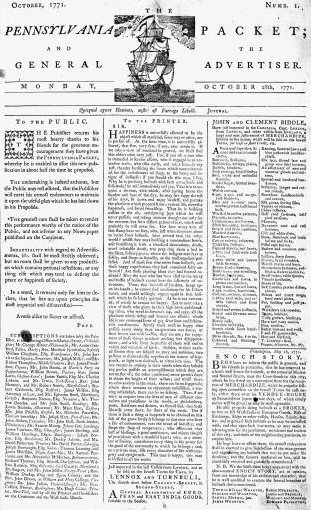
The Pennsylvania Packet - Facebook of the American Revolution
To the free and independent ELECTORS of the City of PHILADELPHIA.
. . The custom has been to deny the right of voting to all persons who have come from Germany, &c. until they have been naturalized, and taken such oaths as men now-a-days much object to; and what seems peculiar to this city alone, all men below the estate of fifty pounds are precluded. Now I must profess myself of the Forester’s opinion, that every man in the country who manifests a disposition to venture his all for the defence of its Liberty, should have a voice in its Councils. . . .
From an open letter published on April 29, 1776 in Dunlap's Pennsylvania Packet
In this day of protests and rebellions organized through Facebook and other online resources, we wonder how something like the American Revolution could have ever been organized and the word spread.
Every city in early America had a newpaper. These periodicals were small, usually 3 or 4 columns, only one page, and published at most a few times a week. They didn't have investigative reporters, but they would print just about any document brought in to them. These papers were delivered to those who could read and afford subscriptions, but were also read aloud in taverns and other gathering places.
In the 1770s, John Dunlap printed his Pennsylvania Packet three times a week. In 1780, he joined forces with David Claypoole who eventually took over publication. In 1784, the Packet became America's first daily newspaper.
Francis Hopkinson, signer of the Declaration, wrote many essays and poems for the Packet. His "Battle of the Kegs", a parody describing events of British-occupied Philadelphia, was published in March of 1778 and his tribute to General Washington, titled "A Toast" came out the next month.
"A Toast" can be heard on Colonial Revelers 1st CD, Revelry, Reflection & Revolution, along with "God Save Our Thirteen States," printed in the Pennsylvania Packet in 1779.
Your humble servants,
HH
Monday, September 26, 2011
October 2011 Events
(latest first)
Saturday, October 8, 9 am - 4 pm - FREE
Downingtown Friends Fall Festival
800 Lancaster Avenue
Downingtown, PA
Colonial Revelers will perform at noon - a lunchtime concert of songs popular between 1700 and 1800.
In 1774, John Downing donated land for the Lionville Friends to build a school. Friends around "Downing's Town" were granted permission to meet at the school in 1784. In 1806, Jenu Roberts donated land for the building of a meetinghouse for Downingtown Friends.
For more information about Downingtown Friends and this event, click here, phone 610-269-4223 or email info@downingtownfriendsmeeting.org
~~~~~~~~~~~~
Saturday, October 1, 10 pm - 4 pm - FREE
Newlin Mill Fall Festival
219 South Cheyney Rd
Glen Mills, PA
Colonial Revelers will perform two sets of period music at 11:30 am and 1:30 pm. Also on hand will be living history and craft demonstrations and tours of the house and mill.
Newlin Mill is the oldest operating grist mill in Pennsylvania. It was built by Nathaniel Newlin in 1704, the third mill built on the site by the Newlin family, who had come to America in 1683. The mill was run by the Newlins until 1817, then by other owners through 1941. A descendent of the Newlin family bought it in 1958 and began restoring it to its 18th century appearance. Besides the mill, this living history site has two houses, an office, a barn and a grain storage building.
For more information about the park, its history, and this event click here , email
info@newlingristmill.org or call 610-459-2359.
Saturday, October 8, 9 am - 4 pm - FREE
Downingtown Friends Fall Festival
800 Lancaster Avenue
Downingtown, PA
Colonial Revelers will perform at noon - a lunchtime concert of songs popular between 1700 and 1800.
In 1774, John Downing donated land for the Lionville Friends to build a school. Friends around "Downing's Town" were granted permission to meet at the school in 1784. In 1806, Jenu Roberts donated land for the building of a meetinghouse for Downingtown Friends.
For more information about Downingtown Friends and this event, click here, phone 610-269-4223 or email info@downingtownfriendsmeeting.org
~~~~~~~~~~~~
Saturday, October 1, 10 pm - 4 pm - FREE
Newlin Mill Fall Festival
219 South Cheyney Rd
Glen Mills, PA
Colonial Revelers will perform two sets of period music at 11:30 am and 1:30 pm. Also on hand will be living history and craft demonstrations and tours of the house and mill.
Newlin Mill is the oldest operating grist mill in Pennsylvania. It was built by Nathaniel Newlin in 1704, the third mill built on the site by the Newlin family, who had come to America in 1683. The mill was run by the Newlins until 1817, then by other owners through 1941. A descendent of the Newlin family bought it in 1958 and began restoring it to its 18th century appearance. Besides the mill, this living history site has two houses, an office, a barn and a grain storage building.
For more information about the park, its history, and this event click here , email
info@newlingristmill.org or call 610-459-2359.
Saturday, August 27, 2011
September 2011 Events
(latest first)
Sunday, September 18, Noon-4 pm
Stafford Heritage Picnic
Manahawkin Lake Park
49 West Bay Ave
(Rte 9 and Main Sts)
Manahawkin, NJ
Colonial Revelers will stroll around the lake and sing at this great multi-era living history event.
In the early part of the decade, Stafford Heritage Days took up a whole weekend and included a reenactment of the Battle of Cedar Bridge, the last engagement of the Revolution (darn those New Jersey loyalists!). Living history groups of all eras showed up, including colonial pirates, temperance ladies, a vintage baseball team, and the most eerily realistic General Grant, Chamberlain and Mr. and Mrs. Lincoln you'd ever want to meet. Then the recession hit, resources were limited and the project was put on hold. This year, we're glad to see a comeback. Come out and join us. It's always fun.
~~~~~~~~~~~
Sunday, September 11, 11 am - 3 pm
Battle of Brandywine Reenactment
Brandywine Battlefield
Rou
Chadds Ford, PA
Colonial Revelers will provide period music in the living history area whenever guns and cannons are silent.
The Battle of Brandywine took place on September 11, 1777 and was the largest battle of American Revolution, with Washington's forces numbering about 15,000 and the British with perhaps 17,000 troops. Washington held a decent position on the hills above the Brandywine Creek, but he was in a loyalist/pacifist neighborhood. Deliberate misinformation, poor communication, bad reconnaissance and inexperienced soldiers all contributed to the American defeat, yet they were able to retreat to Chester and regroup. The British were hampered by the heat of the day and the length of time they took to march around the American flank to ford the creek.
Come tour Washington's and Lafayette's Headquarters, view living history demonstrations, eat colonial food and, of course, hear Colonial Revelers sing.
Wednesday, August 3, 2011
In The Good Old Colony Days
by Elena Santangelo
Between the Declaration of Independence in 1776 and the Constitution eleven years later, the United States had no federal government and no federal taxes. A Tea Partyers dream.
Only a loose Confederation held the states together. Each state had its own laws, ways of raising revenue, and even its own paper currency. Then again, not many folks wanted the bills anyway. The only money worth anything was gold and silver coins, and they were hard won. In those years, after fighting an expensive war, the country was broke and in its first economic depression.
Many of the soldiers who fought in the Continental Army weren't given their back pay or pensions. The states had their own militias to worry about. Greedy men took advantage of the situation, like the Morrises, who held a monopoly in trade agreements for tobacco.
Here's an old 17th century song that resurged in popularity during that decade:
The first line says it all. In the 1780s, lots of folks lamented the "good old colony days" before the Revolution. The song goes on to tell how the miller stole corn, the weaver stole yarn, and "the little tailor, he stole broadcloth for to keep the three rogues warm." The poor and working classes in America could more than identify with the rogues' need to provide themselves with food and clothing.
However, all sinners must be punished so
Eventually, though, the Constitution provided for a strong and flexible Federal government and decent trade with Europe was established, bringing Americans fancy French imports like flannel, denin and corduroy (giving little tailors a wider choice of fabrics).
Still, while the America of the 1780s wasn't the government-less Utopia some citizens envision today, there was no Capitol Hill, and no Congress as we now know it. So how bad could it have been?
Between the Declaration of Independence in 1776 and the Constitution eleven years later, the United States had no federal government and no federal taxes. A Tea Partyers dream.
Only a loose Confederation held the states together. Each state had its own laws, ways of raising revenue, and even its own paper currency. Then again, not many folks wanted the bills anyway. The only money worth anything was gold and silver coins, and they were hard won. In those years, after fighting an expensive war, the country was broke and in its first economic depression.
Many of the soldiers who fought in the Continental Army weren't given their back pay or pensions. The states had their own militias to worry about. Greedy men took advantage of the situation, like the Morrises, who held a monopoly in trade agreements for tobacco.
Here's an old 17th century song that resurged in popularity during that decade:
In the Good Old Colony Days
When we lived under the king,
Lived a miller and a weaver and a little tailor--
Three jolly rogues of Lynn.
When we lived under the king,
Lived a miller and a weaver and a little tailor--
Three jolly rogues of Lynn.
The first line says it all. In the 1780s, lots of folks lamented the "good old colony days" before the Revolution. The song goes on to tell how the miller stole corn, the weaver stole yarn, and "the little tailor, he stole broadcloth for to keep the three rogues warm." The poor and working classes in America could more than identify with the rogues' need to provide themselves with food and clothing.
However, all sinners must be punished so
The miller drowned in his dam,
And the weaver hung in his yarn,
And the Devil laid his Claw on the little tailor
With the broadcloth under his arm.
And the weaver hung in his yarn,
And the Devil laid his Claw on the little tailor
With the broadcloth under his arm.
Eventually, though, the Constitution provided for a strong and flexible Federal government and decent trade with Europe was established, bringing Americans fancy French imports like flannel, denin and corduroy (giving little tailors a wider choice of fabrics).
Still, while the America of the 1780s wasn't the government-less Utopia some citizens envision today, there was no Capitol Hill, and no Congress as we now know it. So how bad could it have been?
Friday, July 1, 2011
EVENTS
Sunday, July 3 at 9:30 am
St. Matthews United Methodist Church of Valley Forge
600 Walker Road
Wayne, PA 19087
On the eve of the anniversary of our Independency, Colonial Revelers will perform the music of Mr. William Billings and Mr. John Cole during Sunday morning services at St. Matthews.

Saturday, July 30, 10-4
Frederick Muhlenberg House
151 W. Main Street
Trappe, PA 19426
Colonial Revelers will provide 18th century songs from 11 to 1 at the Speaker's House Living History Day, a BBQ fundraiser for the restoration of the Frederick Muhlenberg House. Lunch will be pork BBQ, cole slaw, corn-on-the-cob and soft drink. Activities include colonial cooking, music, spinning, dying, weaving, blacksmithing, woodworking, military demonstrations and tours of the house. Tickets are $10 for adults, $7 for seniors, $5 for kids 6-12, and free for children under 6.
Frederick Muhlenberg became the first U.S. Congress Speaker of the House in 1789. The house was built in 1760 and purchased by Muhlenberg in 1781. He was born and grew up in Trappe. The house of his father, Henry Melchior Muhlenberg, has also been restored by the Trappe Historical Society. Henry was a Lutheran pastor sent to Pennsylvania in the 18th century as a missionary. Besides Frederick, his sons included Major General Peter Muhlenberg of the Continental Army. Sons-in-law were also generals and politicians, and one grandson became Governor of Pennsylvania.
For more information, call 610-489-2105 or email info@speakershouse.org
FYI: The Keystone Grange Fair is the same day, not far away on West 1st Avenue, 9 am-7 pm. Come and spend the whole day in Trappe!
We would be pleased to see you this month.
Your humble servants,
HH
St. Matthews United Methodist Church of Valley Forge
600 Walker Road
Wayne, PA 19087
On the eve of the anniversary of our Independency, Colonial Revelers will perform the music of Mr. William Billings and Mr. John Cole during Sunday morning services at St. Matthews.

Saturday, July 30, 10-4
Frederick Muhlenberg House
151 W. Main Street
Trappe, PA 19426
Colonial Revelers will provide 18th century songs from 11 to 1 at the Speaker's House Living History Day, a BBQ fundraiser for the restoration of the Frederick Muhlenberg House. Lunch will be pork BBQ, cole slaw, corn-on-the-cob and soft drink. Activities include colonial cooking, music, spinning, dying, weaving, blacksmithing, woodworking, military demonstrations and tours of the house. Tickets are $10 for adults, $7 for seniors, $5 for kids 6-12, and free for children under 6.
Frederick Muhlenberg became the first U.S. Congress Speaker of the House in 1789. The house was built in 1760 and purchased by Muhlenberg in 1781. He was born and grew up in Trappe. The house of his father, Henry Melchior Muhlenberg, has also been restored by the Trappe Historical Society. Henry was a Lutheran pastor sent to Pennsylvania in the 18th century as a missionary. Besides Frederick, his sons included Major General Peter Muhlenberg of the Continental Army. Sons-in-law were also generals and politicians, and one grandson became Governor of Pennsylvania.
For more information, call 610-489-2105 or email info@speakershouse.org
FYI: The Keystone Grange Fair is the same day, not far away on West 1st Avenue, 9 am-7 pm. Come and spend the whole day in Trappe!
We would be pleased to see you this month.
Your humble servants,
HH
Friday, June 10, 2011
If You Can't Stand The Heat...
"Hide not your talents, they for use were made.
What's a sun-dial in the shade?"
Benjamin Franklin, Poor Richard's Almanack
A suitable reply to the above question today might well be that a sun-dial in the shade would be cooler.
In an effort to provide relief to ourselves and our readers, we list here time-tested methods of dealing with the summer heat.
1. If you must labor outside, a fresh, damp cabbage leaf placed 'twixt cap and head will keep you cooler. This is a centuries old method, most recently employed famously by a ballplayer named Babe Ruth. Change the leaf every few hours.
2. Dig a hole. On a hot summer's day, the bottom of a 6 foot hole will be at least 20 degrees Fahrenheit cooler than the top. For those who shy from this solution, likening it to being laid
untimely in their graves, perhaps use the hole only to store perishable food. Add a large chunk of ice, well-salted and wrapped in flannel, and your milk, butter, and fresh meat will
keep well.
3. Should digging a hole prove strenuous in the heat, you may lower your jugs of milk and such to the bottom of your well with the same results.
4. For those fortunate to have a cellar beneath their homes, 'tis a fine, cool place to dwell on a warm afternoon, all the more so if no one thinks to look for you there. Bring a book and a few pints of good ale (chilled first in the well) to help pass the hours. If discretion is unnecessary, leave the book above and bring your friends below for an afternoon of song.
Your humble servants,
HH
Subscribe to:
Posts (Atom)